Before buying any token on Solana, you should scan it. Not checking is like crossing a highway blindfolded — you might make it, but the odds aren't in your favor.
Token scanners analyze a token's smart contract, holder distribution, liquidity status, and creator behavior to flag potential scams. On Solana, where thousands of new tokens launch daily and rug pulls are commonplace, a scanner is your first line of defense.
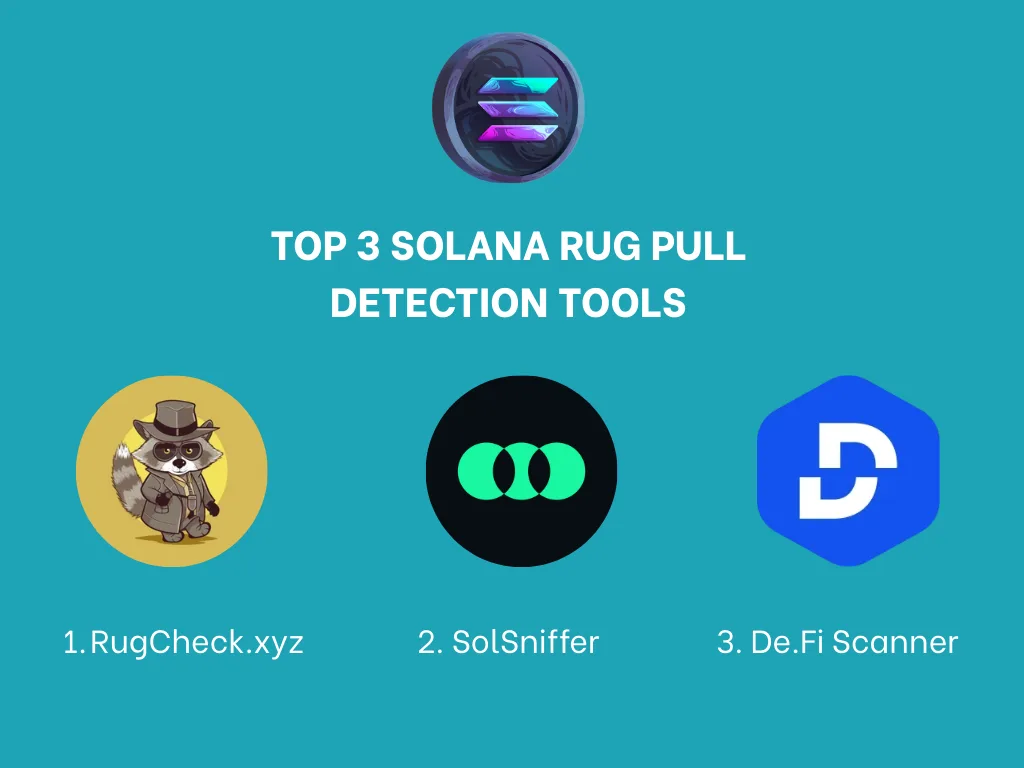
This review compares the three most popular token scanners for Solana: RugCheck, Solsniffer, and De.Fi. We'll evaluate what each checks, how accurate they are, and when to use each one.
What Token Scanners Check
All three scanners analyze similar risk factors, though they weight and present them differently:
Authority Checks
Mint authority: Can the creator mint (print) unlimited new tokens? If mint authority isn't revoked, the creator can create new supply at any time, diluting all existing holders. This is one of the most critical red flags.
Freeze authority: Can the creator freeze individual token accounts? With freeze authority active, the creator can prevent you from selling — the definition of a honeypot.
Update authority (metadata): Can the creator change the token's name, symbol, or image? Less dangerous than mint/freeze, but can be used for bait-and-switch scams (launch as "PEPE", rename to something else).
Liquidity Analysis
LP status: Is the liquidity pool's LP locked, burned, or freely withdrawable? Unlocked LP means the creator can drain all liquidity at any time.
LP concentration: What percentage of LP tokens does the creator hold? If one wallet controls most of the LP, that's a centralization risk.
Pool size: How much SOL/USDC is in the trading pool? Thin liquidity means even small sells can crash the price.
Holder Distribution
Top holder concentration: If the top 10 holders own 80% of supply, a coordinated sell would destroy the price. Healthy distribution means no single entity can crash the market.
Creator holdings: How many tokens does the creator wallet hold? A creator sitting on 20% of supply is a major dump risk.
Bundle detection: Are multiple wallets that look independent actually controlled by the same entity? Bundle wallets are used to fake decentralized holding.
Contract Analysis
Immutable metadata: Is the token's metadata account immutable (cannot be changed)?
Program ownership: Is the token using the standard SPL token program, or a custom program with unknown behavior?
RugCheck
RugCheck is Solana's most widely used token scanner. It's the de facto standard that most Solana traders check before buying, and it has since extended the same scanning to Fogo, the SVM-compatible chain — its Solana coverage and workflow described below are unchanged.
What RugCheck Analyzes
- Mint authority status (revoked or active)
- Freeze authority status (revoked or active)
- LP lock/burn status
- Top holder concentration
- Creator token holdings
- Market and liquidity data
- Metadata mutability
How RugCheck Presents Results
RugCheck gives each token a risk assessment with clear categories:
- Good: No major red flags detected. Authorities revoked, LP burned/locked, reasonable holder distribution
- Warning: Some concerning factors but not immediately dangerous. May have concentrated holders or short lock duration
- Danger: Active mint/freeze authority, unlocked LP, extreme holder concentration, or other critical risks
Each risk factor is listed individually with an explanation, so you can see exactly why a token received its rating.
Strengths
Speed and simplicity: Paste a token address, get instant results. No account needed, no setup.
Community trust: RugCheck is the most recognized scanner in the Solana community. When someone says "it passed RugCheck," people understand what that means.
Ecosystem recognition: RugCheck remains a common reference point in Solana trading workflows. BullX is no longer an active comparison point here because trading on its current app was suspended June 1, 2026.
Free: No premium tier needed for basic scans.
LP analysis depth: Particularly good at analyzing LP status — locked, burned, percentage locked, lock duration, and lock provider.
Weaknesses
Limited historical analysis: RugCheck shows the current state of a token but doesn't track how it changed over time. A token might have had mint authority active at launch (red flag) and revoked it later.
No bundle detection: RugCheck doesn't identify coordinated wallet clusters that may be controlled by the same entity.
Binary on some checks: Some factors are presented as pass/fail without nuance. A token with 15% creator holdings gets flagged the same as one with 50%.
Best For
Quick pre-buy safety checks. If you're scanning a token you found on DexScreener or Pump.fun and need a fast go/no-go decision, RugCheck is the standard.
Solsniffer is a Solana-specific scanner centered on its proprietary Snifscore and detailed risk breakdown. Its API (free account sign-up, with paid tiers for higher usage) gives developers programmatic access to its token security data, including batch lookups; check the current API plan for exact call limits.
What Solsniffer Analyzes
- All authority checks (mint, freeze, metadata)
- LP analysis (locked, burned, percentage)
- Holder distribution and concentration
- Token creation details
- Market data (price, volume, market cap)
- Social signals (linked social media accounts)
How Solsniffer Presents Results
Solsniffer assigns a Snifscore from 0-100 and pairs it with individual audit findings. We no longer hard-code universal "80 = safe / 50 = risky" bands here because the product's live scanner exposes the score together with the underlying findings, and the important part is the specific risk signal rather than a MadeOnSol-invented threshold.
Current scans surface items such as mint/freeze authority, holder concentration, liquidity-provider concentration, metadata risks and whether LP is locked or burned.
Strengths
Numerical score: The 0-100 score makes comparison easy. "This token scores 85" is more precise than "this token has some warnings."
Detailed breakdown: Each risk factor gets its own sub-score and explanation. You can see exactly which factors are dragging the score down.
Social verification: Solsniffer checks whether the token has linked social media accounts and verifies their existence. Tokens with no social presence score lower.
Market context: Includes market data alongside security analysis, giving you a fuller picture without switching tools.
Solana-focused: Built specifically for Solana's SPL token standard, so edge cases are handled better than multi-chain tools.
Weaknesses
Score can be misleading: A token might score 75 but have one critical flaw (like active mint authority) that the overall score partially masks. Always read the breakdown, not just the number.
Less community recognition: While growing, Solsniffer doesn't have the same "everyone uses it" status as RugCheck. Saying "it scored 85 on Solsniffer" carries less weight in community discussions.
Fewer integrations: Not as widely integrated into trading bots and tools as RugCheck.
Best For
Detailed risk analysis when you want more granularity than RugCheck provides. Good for comparing multiple tokens side by side using numerical scores.