Providing liquidity on Solana is one of the most direct ways to earn yield in DeFi. Instead of just holding tokens and hoping they go up, you can deposit them into a liquidity pool and earn trading fees every time someone swaps through that pool. On a high-throughput chain like Solana — where DEX volume regularly exceeds billions per day — those fees add up.
But liquidity provision isn't risk-free, and the mechanics differ significantly between platforms. This guide covers everything you need to know: how it works, how to do it on Raydium, Orca, and Meteora, what returns to expect, and how to manage the risks.
How Liquidity Pools Work
A liquidity pool is a smart contract that holds two (or more) tokens. Traders swap between these tokens, and the pool adjusts prices based on supply and demand. Every swap charges a fee — typically 0.01% to 1% — and that fee goes to liquidity providers (LPs) proportional to their share of the pool.
The Basic Mechanics
- You deposit two tokens into a pool (e.g., SOL and USDC) at the current market ratio
- You receive LP tokens representing your share of the pool
- Traders swap through the pool, paying fees on each trade
- Fees accumulate in the pool, increasing the value of your LP tokens
- When you withdraw, you get back your share of both tokens plus accumulated fees
AMM Types on Solana
Constant Product AMM (x * y = k): The classic model. Your liquidity is spread across all prices from 0 to infinity. Simple and passive, but capital-inefficient — most of your liquidity sits at prices far from the current market.
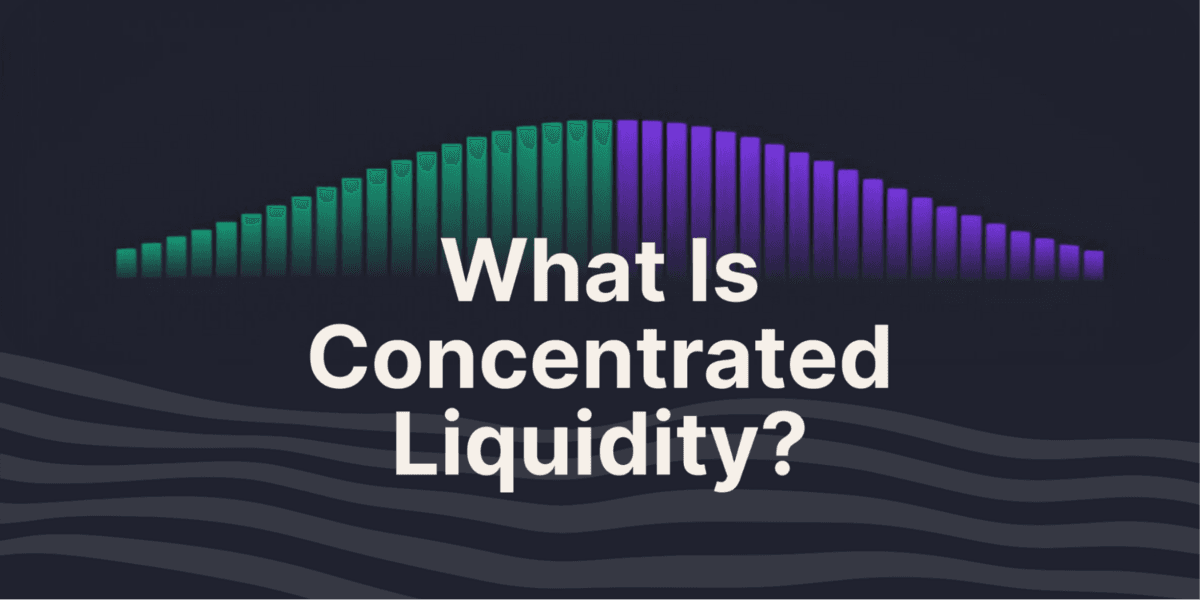
Concentrated Liquidity (CLMM): You choose a specific price range to provide liquidity in. Your capital is more efficient within that range, earning higher fees per dollar deposited. But if the price moves outside your range, you stop earning fees entirely. Our dedicated guide to concentrated liquidity on Solana walks through how to pick ranges and maximize LP returns with this model.
Dynamic Liquidity Market Maker (DLMM): Meteora's innovation. Similar to concentrated liquidity but with discrete price bins instead of continuous ranges. Enables zero-slippage trades within each bin and more granular position management.
Understanding the Risks
Before diving into platform guides, you need to understand what can go wrong.
This is the biggest risk in liquidity provision. When the relative price of your two tokens changes from when you deposited, you end up with fewer of the token that went up and more of the token that went down — compared to simply holding both tokens.
Example: You deposit 10 SOL + 2,000 USDC into a SOL/USDC pool when SOL = $200. If SOL doubles to $400, your pool share becomes roughly 7.07 SOL + 2,828 USDC (worth $5,656). But if you'd just held, you'd have 10 SOL + 2,000 USDC (worth $6,000). The $344 difference is your impermanent loss.
The loss is "impermanent" because if prices return to their original ratio, the loss disappears. But in practice, prices rarely return exactly — especially with volatile assets like memecoins.
Key insight: Impermanent loss is worse with higher price volatility and less correlated token pairs. SOL/USDC has moderate IL risk. SOL/ETH (correlated assets) has lower IL risk. SOL/MEMECOIN has extreme IL risk.
Smart Contract Risk
Pools are smart contracts. Bugs, exploits, or admin key compromises can result in loss of funds. Stick to established, audited protocols.
Token Risk
If one token in your pair goes to zero (rug pull, exploit, depegging), your LP position absorbs the loss. You'll end up holding worthless tokens. This is especially dangerous with low-cap or new tokens.
Raydium
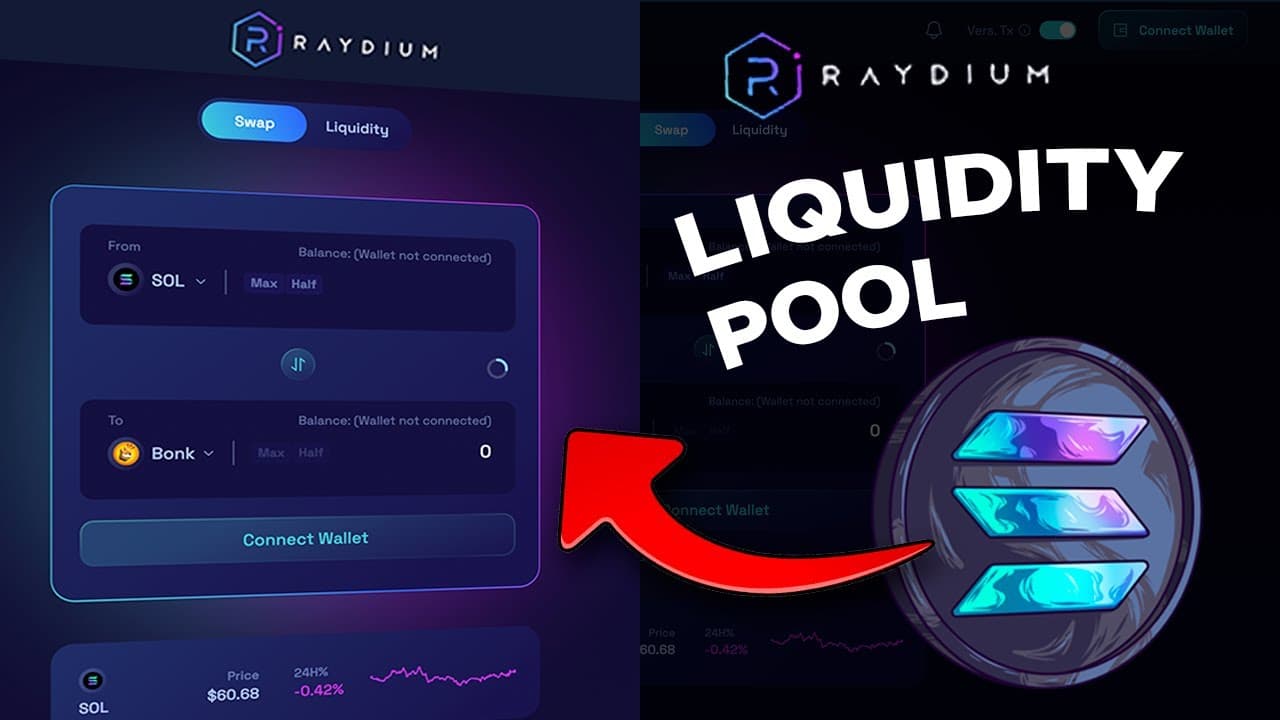
Raydium is Solana's largest DEX by TVL and the default liquidity venue for most Solana tokens. It offers both standard AMM pools and concentrated liquidity (CLMM) pools.
Standard AMM Pools
Raydium's standard pools use the constant product formula. They're the simplest option — deposit tokens at the current ratio and earn fees passively.
How to provide liquidity on Raydium (Standard):
- Go to raydium.io and connect your wallet (Phantom, Solflare, etc.)
- Click Liquidity in the top navigation
- Select Standard tab
- Choose a pool (e.g., SOL-USDC)
- Enter the amount of one token — the other auto-calculates based on the current ratio
- Click Add Liquidity and confirm the transaction in your wallet
- You receive LP tokens representing your pool share
Typical APY: 5-30% for major pairs (SOL/USDC, SOL/USDT). Higher for smaller-cap pairs, but with more risk.
Concentrated Liquidity (CLMM)
Raydium's CLMM pools let you concentrate your liquidity in a specific price range. More capital-efficient, but requires active management.
How to provide concentrated liquidity on Raydium:
- Go to raydium.io → Liquidity → Concentrated tab
- Select a pool and fee tier (0.01%, 0.05%, 0.25%, or 1%)
- Set your price range (lower and upper bounds)
- Enter the amount of one token
- Click Add Liquidity and confirm
Choosing a fee tier:
- 0.01%: Stable pairs (USDC/USDT) — very tight spreads, high volume needed
- 0.05%: Major pairs (SOL/USDC) — good balance of fees and volume
- 0.25%: Mid-cap tokens — moderate volume, higher fee per trade
- 1%: Volatile/low-cap tokens — fewer trades but each one pays well
Choosing a price range:
- Narrow range (e.g., SOL at $180-220 when current price is $200): Higher capital efficiency, more fees per dollar, but higher risk of going out of range
- Wide range (e.g., SOL at $100-400): Safer, stays in range longer, but lower capital efficiency
- Full range: Behaves like a standard AMM pool — no range management needed
Raydium Farms
Some Raydium pools offer additional token rewards (RAY or partner tokens) on top of trading fees. After adding liquidity, you can stake your LP tokens in a Farm to earn these extra rewards.
- Add liquidity to an eligible pool
- Go to Farms section
- Find your pool and click Stake
- Deposit your LP tokens
Farm APYs vary widely — check the current rates before committing.
Orca
Orca is known for its clean interface and pioneered concentrated liquidity on Solana with its Whirlpools product. It's the second-largest Solana DEX and often the most user-friendly option.
Whirlpools (Concentrated Liquidity)
Orca's Whirlpools are concentrated liquidity pools with an emphasis on usability. The interface guides you through range selection with visual aids.
How to provide liquidity on Orca:
- Go to orca.so and connect your wallet
- Click Pools in the navigation
- Search for or browse available Whirlpools
- Select a pool (e.g., SOL/USDC)
- Choose a fee tier if multiple are available
- Set your price range using the slider or manual input
- Orca shows a helpful visualization of your range relative to the current price
- Enter your deposit amount
- Click Deposit and confirm
Orca's Range Suggestions: Orca offers preset range options (Narrow, Medium, Wide) based on recent price volatility. This is helpful if you're not sure how tight to set your range.
Orca Double-Dip Rewards
Some Whirlpools offer additional token rewards from projects that want to incentivize liquidity. These show up as "Rewards" in the pool listing and are claimed separately from trading fees.
Managing Your Position
Orca's dashboard shows your active positions, current value, fees earned, and whether your position is in range. Key actions:
- Collect Fees: Claim accumulated trading fees without closing your position
- Close Position: Withdraw all liquidity and close the position
- Increase Liquidity: Add more tokens to an existing position at the same range
Meteora
Meteora has become the go-to platform for advanced LPs, particularly for memecoin and new token launches. Its Dynamic Liquidity Market Maker (DLMM) pools offer unique advantages.
How DLMM Works
Instead of a continuous price curve, DLMM uses discrete price bins. Each bin represents a specific price point, and you can allocate different amounts of liquidity to different bins. This gives you granular control over your liquidity distribution.
Key advantages of DLMM:
- Zero slippage within a bin: Trades that stay within a single bin execute at the exact bin price
- Flexible distribution: Allocate more liquidity around the current price and less at the extremes
- Bin step options: Choose the granularity (1 bin step = very tight pricing, 100 bin steps = wider)
- One-sided liquidity: You can provide just one token if the current price is at the edge of your range
How to Provide Liquidity on Meteora
Standard DLMM Pool:
- Go to meteora.ag and connect your wallet
- Click DLMM in the navigation
- Browse pools or search for a specific pair
- Select a pool and choose a bin step (lower = tighter pricing)
- Choose a distribution strategy:
- Spot: Equal liquidity across all bins in your range (balanced)
- Curve: More liquidity concentrated near the current price (bell curve)
- Bid-Ask: More liquidity at the edges of your range (for range-bound markets)
- Set your price range
- Enter your deposit amount
- Click Add Liquidity and confirm
Meteora Dynamic Pools
Meteora also offers standard dynamic pools (non-DLMM) that automatically rebalance. These are simpler — you deposit both tokens and the protocol handles the rest. Lower yields than DLMM but fully passive.
Meteora Launch Pools
Meteora is popular for token launches. Projects use Meteora's Alpha Vault or Launch Pool features to bootstrap liquidity for new tokens. If you're providing liquidity for a new token launch, Meteora is likely where it happens.
Risk warning: Launch pools for new tokens carry extreme risk. The token could lose 90%+ of its value, and your LP position will absorb that loss through impermanent loss.