Orca Whirlpools Guide: Concentrated Liquidity on Solana Explained (2026)
Complete guide to Orca DEX and Whirlpools — Solana's concentrated liquidity protocol. Learn how to swap, provide liquidity, manage price ranges, and compare Orca vs Meteora DLMM vs Raydium CLMM.
MadeOnSol·· 12 min read
Disclosure: This article contains affiliate links. If you sign up through them, MadeOnSol may earn a commission at no extra cost to you. This never affects our rankings, ratings, or reviews.
Model: Uniswap V3-style concentrated liquidity with customizable price ranges
Fee tiers: Fixed tiers (0.01%, 0.04%, 0.3%, 1%)
Strengths: Deepest liquidity for major pairs, clean UI, well-audited, longest track record on Solana
Weaknesses: Requires active management, no auto-compounding of fees
Best for: Major pairs (SOL/USDC, SOL/USDT), LPs who want the most established protocol
Meteora DLMM
Meteora uses a Dynamic Liquidity Market Maker (DLMM) model based on Trader Joe's Liquidity Book design. Instead of continuous price curves, liquidity is organized into discrete price "bins."
Model: Bin-based liquidity with different distribution strategies (spot, curve, bid-ask)
Fee model: Dynamic fees that increase during volatile periods and decrease during calm periods
Strengths: More granular control with bin placement, dynamic fees capture more during volatility, very popular for memecoin launches, auto-compounding in some strategies
Weaknesses: Newer protocol, more complexity in choosing distribution strategies
Best for: Memecoin pairs, volatile tokens, LPs who want dynamic fee capture
Raydium CLMM
Raydium launched its concentrated liquidity pools (CLMM) to compete with Orca and Meteora.
Model: Similar to Orca (Uniswap V3-style concentrated ranges)
Strengths: Raydium has strong brand recognition, integrated with their standard AMM and LaunchLab
Weaknesses: Less TVL in CLMM pools compared to Orca for major pairs, fewer unique features
Best for: Tokens that launched on Raydium and naturally have liquidity there
Comparison Table
Feature
Orca Whirlpools
Meteora DLMM
Raydium CLMM
Liquidity model
Continuous ranges
Discrete bins
Continuous ranges
Tools mentioned
Compare features and read reviews.
Live health scores, average ratings, and direct links on MadeOnSol.
Orca is one of the original Solana DEXes and the pioneer of concentrated liquidity on the chain. While Jupiter dominates swap aggregation (routing through Orca, Raydium, and others to find the best price), Orca itself is where much of Solana's deepest liquidity actually lives — particularly for major pairs like SOL/USDC, SOL/USDT, and blue-chip DeFi tokens.
Orca's concentrated liquidity pools, called Whirlpools, let liquidity providers (LPs) focus their capital within specific price ranges rather than spreading it across the entire price spectrum. This is more capital-efficient but requires active management. This guide covers everything: basic swaps, how Whirlpools work, how to provide liquidity step-by-step, and when to use Orca vs. the alternatives.
Swapping on Orca
For simple token swaps, most users go through Jupiter's aggregator rather than Orca directly. Jupiter checks all Solana DEXes and routes your trade for the best price — and Orca pools are a major source of that liquidity.
Use Jupiter for most swaps — the aggregator almost always finds equal or better pricing
Use Orca directly if you want to interact with a specific pool (for example, to swap into a pool you're about to LP in), or if Jupiter is experiencing issues
Orca charges a swap fee that varies by pool (typically 0.01% to 1%, depending on the pair's volatility). This fee goes to liquidity providers.
What Are Whirlpools (Concentrated Liquidity)?
Traditional AMM pools (like Uniswap V2 or old Raydium) spread liquidity evenly across all possible prices, from $0 to infinity. This means most of the capital sits idle at price ranges that never get used. If SOL is trading at $150, liquidity sitting at the $5 and $10,000 ranges does nothing.
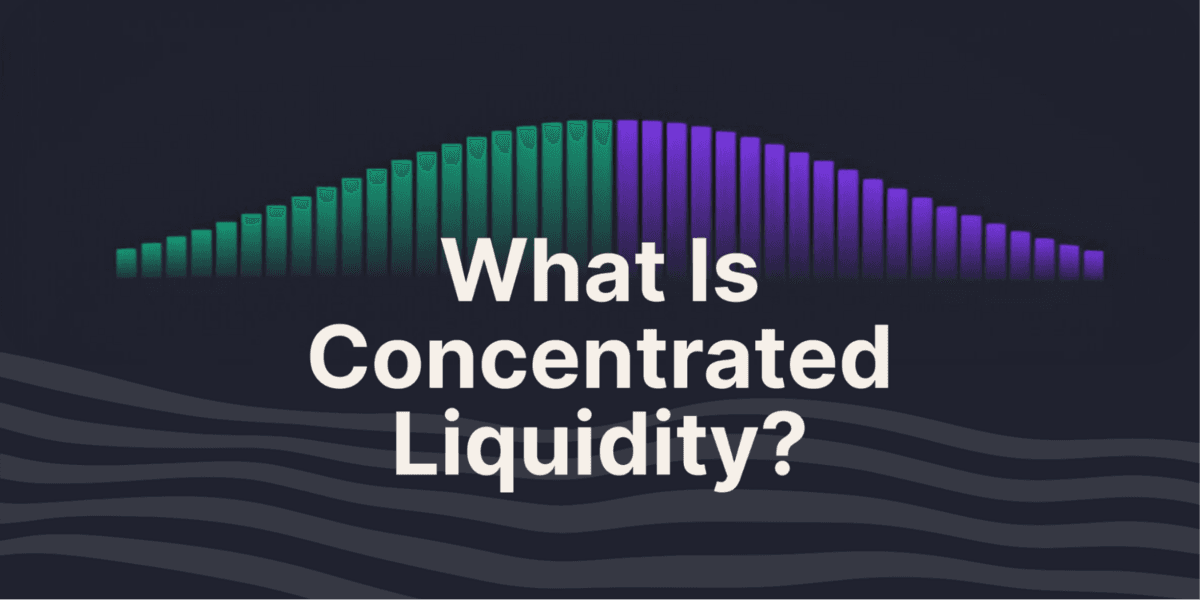
Concentrated liquidity (pioneered by Uniswap V3 and adopted by Orca Whirlpools) lets you choose a specific price range to provide liquidity in. Instead of covering $0 to infinity, you might provide SOL/USDC liquidity in the $120-$180 range. All your capital is active within that range, making it dramatically more capital-efficient.
The numbers: A concentrated position in a tight range can provide the same effective liquidity as a traditional position 100-1000x larger. A $1,000 concentrated position can do the work of $100,000+ in a traditional pool.
How Whirlpool Price Ranges Work
When you create a Whirlpool position, you set:
Lower price: The bottom of your range (e.g., SOL = $120)
Upper price: The top of your range (e.g., SOL = $180)
Deposit amounts: The pool calculates how much of each token you need based on the current price relative to your range
Key behaviors:
Current Price vs. Range
What Happens
Your Position Holds
Below your range
You earn zero fees
100% Token B (e.g., all SOL)
Within your range
You earn trading fees
Mix of both tokens
Above your range
You earn zero fees
100% Token A (e.g., all USDC)
When the price moves out of your range, you stop earning fees entirely. Your position sits idle until the price returns to your range, or you close it and reopen at a new range.
This is the fundamental tradeoff: tighter ranges earn more fees per dollar when active, but go out of range more frequently. Wider ranges earn less per dollar but stay active longer.
Step-by-Step: Providing Liquidity on Orca Whirlpools
Step 1: Choose a Pool
Go to orca.so/pools and browse available pools. Key metrics to evaluate:
TVL (Total Value Locked): Higher TVL generally means more stable returns. Major pools like SOL/USDC have hundreds of millions in TVL
Volume (24h/7d): Higher volume = more fee revenue for LPs
Fee tier: Pools come in different fee tiers (0.01%, 0.04%, 0.3%, 1%). Lower fee tiers suit stable pairs (USDC/USDT). Higher fee tiers suit volatile pairs (memecoin/SOL)
Fee APR: Estimated annual return from fees. Be cautious — this doesn't account for impermanent loss
Step 2: Set Your Price Range
This is the most important decision. Your range determines your fee earnings, risk exposure, and management frequency.
For stable pairs (USDC/USDT):
Tight range: 0.999-1.001 (very concentrated, highest fees if it stays pegged)
Safe range: 0.995-1.005 (rarely goes out of range)
Stablecoin pairs rarely depeg significantly, so tight ranges work well
For volatile pairs (SOL/USDC):
Tight range: Current price +/- 10% (high fees but requires frequent rebalancing)
Medium range: Current price +/- 25-30% (good balance of fees and staying in range)
Wide range: Current price +/- 50%+ (lower fees but less management)
Full range: Equivalent to a traditional AMM (lowest fees but always in range)
Pro tip: Look at the price history on DexScreener or Birdeye to see how the pair has moved over the past 7-30 days. Set your range to cover that historical movement plus some buffer.
Step 3: Deposit Tokens
Once you've set your range:
The interface shows how much of each token you need to deposit
The ratio depends on where the current price sits within your range
If the price is at the center of your range, you'll deposit roughly equal dollar value of each token
If the price is near your lower bound, you'll deposit more of the base token (e.g., SOL)
Approve the transaction — this creates your LP position as an NFT in your wallet
Step 4: Monitor and Manage
After depositing, you need to actively manage your position:
Check if you're in range: Orca's dashboard shows whether the current price is within your range. If it's out of range, you're earning zero fees
Collect fees: Fees accrue automatically but you need to manually claim them. Click "Collect Fees" on your position
Rebalance when needed: If the price moves out of your range, you have two options:
Wait for it to come back (risky if the trend continues)
Close the position, swap tokens back to the right ratio, and open a new position at the current price
Understanding Impermanent Loss in Concentrated Liquidity
Impermanent loss (IL) is amplified in concentrated liquidity. Here's why:
In a traditional pool, if SOL goes from $150 to $200, you experience some IL but you've been earning fees the whole time. In concentrated liquidity, if your range is $130-$170 and SOL goes to $200:
As SOL rose through your range ($130-$170), you were selling SOL for USDC (the AMM's natural behavior)
At $170, your position became 100% USDC and 0% SOL
SOL continued to $200 — you missed the entire move from $170 to $200
If you'd just held SOL, you'd have gained more
The tighter your range, the more IL you experience when the price moves directionally. This is the cost of higher capital efficiency.
The question is always: do the fees earned offset the impermanent loss? For stable pairs and high-volume pairs, often yes. For low-volume or highly directional markets, often no.
Fee tiers
Fixed (0.01-1%)
Dynamic (auto-adjusts)
Fixed
TVL (major pairs)
Highest
Growing fast
Moderate
Memecoin LP
Limited
Best choice
Good
Auto-compound
No (manual claim)
Some strategies
No
UI/UX
Clean, simple
More complex
Straightforward
Track record
Since 2021
Since 2023
CLMM since 2023
Bottom line: For stable/major pairs, Orca is the default. For memecoins and volatile tokens, Meteora DLMM is usually better due to dynamic fees. Raydium CLMM is fine but doesn't have a clear advantage over either.
Wide asymmetric range: Set your range wider on the upside. Example for SOL at $150: range $130-$220
Accept single-sided risk: In a strong uptrend, your position will convert mostly to USDC. Either accept this or don't LP volatile pairs during strong trends
Consider single-sided deposits: Some pools allow depositing only one token. You can go single-sided USDC and earn fees without SOL exposure
Bear Market (Trending Down)
Widen your range significantly: Price drops can be sharp. A 20% range isn't enough
Focus on stablecoin pairs: USDC/USDT or other stable pairs have minimal IL risk regardless of market conditions
Reduce overall LP exposure: In a bear market, holding cash often beats LPing
Sideways/Choppy Market
This is the ideal LP environment: Price oscillates within a range, generating fees without directional IL
Use tighter ranges: If SOL is chopping between $140-$160, a $135-$165 range earns excellent fees
Monitor volume: Choppy markets sometimes have lower volume, which means lower fees despite good range utilization
Memecoin LP
Use Meteora DLMM, not Orca: Dynamic fees capture the extreme volatility of memecoins
Expect IL: Memecoins move 50-90% in a day. Your position will go out of range frequently
Focus on launch liquidity: The highest fees come in the first hours/days of a token's life when volume is extreme relative to liquidity
Be prepared to lose: Memecoin LP is high risk, high reward. The token might go to zero
Common Mistakes to Avoid
Setting ranges too tight: New LPs often set very tight ranges chasing high APR numbers. The position goes out of range within hours, and the rebalancing costs (swap fees + slippage + transaction fees) eat into profits
Not claiming fees: Fees don't auto-compound on Orca. If you forget to claim and reinvest, you're leaving returns on the table
Ignoring IL in APR calculations: Orca shows fee APR, not net APR. If a pool shows 80% APR but you're losing 30% to IL, your real return is much lower
LPing tokens you don't want to hold: Concentrated liquidity converts your tokens as the price moves. If you LP a SOL/USDC pool and SOL drops 50%, you end up holding mostly SOL at a loss. Only LP pairs where you're comfortable holding both assets
Not checking historical volume: A pool might show high APR from one day of unusual volume. Check 7-day and 30-day averages for realistic expectations
Over-concentrating in one pool: Diversify across multiple pools and strategies. Don't put all your capital in one position
Getting Started: Practical Recommendations
If you're new to LP:
Start with a stablecoin pair (USDC/USDT) on Orca to learn the mechanics with minimal risk
Use a wide range (0.995-1.005) and a small amount ($50-100)
Watch how fees accrue, practice claiming, and understand the interface
Graduate to SOL/USDC with a wide range once you're comfortable
If you're experienced:
Split capital across Orca (major pairs) and Meteora (volatile pairs)
Use tighter ranges on Orca for higher fee capture on stable positions
Experiment with Meteora's distribution strategies (curve, bid-ask) for volatile tokens
Track your positions' performance net of IL — tools like Birdeye can help
Concentrated liquidity on Solana is one of the most capital-efficient ways to earn yield in DeFi. But it's not passive income — it requires understanding, monitoring, and active management. Treat it as a skill to develop, start small, and scale up as you build confidence.
For standard-pool liquidity provision instead of concentrated ranges, see our Raydium guide. For simple swapping without LP management, see our Jupiter Exchange guide.