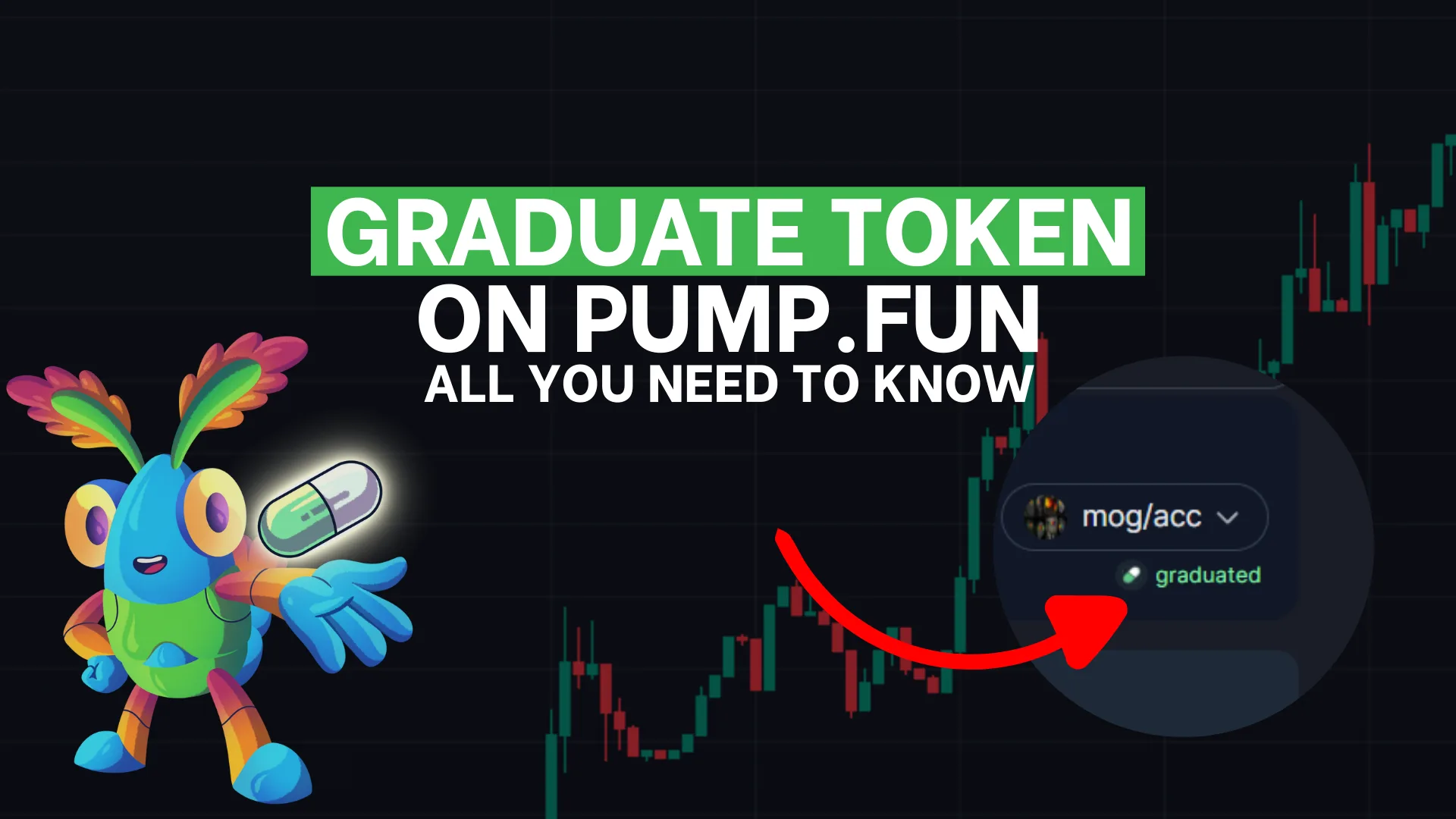
Every token launched on Pump.fun starts on a bonding curve. When enough people buy in and the curve fills up, the token "graduates" — migrating from Pump.fun's internal system to a real DEX pool. This graduation event is the most critical moment in a Pump.fun token's lifecycle.
Understanding exactly what happens during graduation — the mechanics, the timing, the price dynamics — gives you an edge whether you're creating a token or trading one. This guide breaks down the entire process from first buy to post-graduation trading.
What Is a Bonding Curve?
A bonding curve is a mathematical formula that determines a token's price based on its supply. On Pump.fun, the bonding curve works like this:
- When a token is created, 100% of the supply exists but is "held" by the bonding curve contract
- As buyers purchase tokens, SOL flows into the curve and tokens flow out
- Each successive purchase is more expensive than the last — the price increases along the curve
- If someone sells, they sell tokens back to the curve and receive SOL — the price decreases
The curve is deterministic: given the total SOL deposited, you can calculate the exact token price. There's no order book, no market makers, and no liquidity pool — just math.
How the Price Moves
Imagine the bonding curve as a hill. At the bottom (few buyers), tokens are extremely cheap. As more people buy and walk up the hill, the price gets steeper. The first buyer might get tokens at $0.000001. The buyer who fills the last portion of the curve might pay 100x more.
This creates a natural incentive structure:
- Early buyers get the best price but take the most risk (will anyone else buy?)
- Later buyers pay more but have more confirmation that there's interest
- Sellers push the price back down the curve, creating losses for buyers who entered above the current price
The Numbers
On Pump.fun, the bonding curve parameters are:
- Total token supply: Typically 1 billion tokens
- Bonding curve allocation: ~800 million tokens available during the curve phase
- Graduation threshold: Approximately 85 SOL must be deposited into the curve
- Remaining tokens: ~200 million tokens are reserved for the DEX liquidity pool at graduation
These numbers mean that when the curve is full, the implied market cap is roughly $60,000-80,000 (depending on SOL price). This is the market cap at graduation. If you are new to the platform itself, our complete beginner guide to using Pump.fun covers creating and trading a token before you reach the graduation stage.
What Triggers Graduation?
Graduation happens automatically when the bonding curve is fully filled — meaning approximately 85 SOL has been deposited by buyers. There's no manual trigger, no voting, and no delay. Once the threshold is hit, the process begins immediately. Only a small fraction of launches ever get there — our Pump.fun deployer stats for March 2026 break down how graduation rates differ sharply between elite and rising deployers.
The Graduation Sequence
Here's exactly what happens, step by step:
Step 1: Threshold reached. A buy transaction pushes the total SOL in the curve past the graduation threshold.
Step 2: Trading pauses. Buying and selling on the bonding curve stops temporarily. You cannot trade the token on Pump.fun during migration.
Step 3: Liquidity pool creation. Pump.fun's smart contract creates a new liquidity pool on PumpSwap, pump.fun's own AMM (since March 2025; before that, graduations went to Raydium). The pool is seeded with:
- The SOL accumulated in the bonding curve (minus Pump.fun's fee)
- The remaining token supply reserved for liquidity (~200 million tokens)
Step 4: LP tokens are burned. The LP tokens representing ownership of this liquidity pool are sent to a burn address. This makes the liquidity permanent — no one can ever withdraw it.
Step 5: Trading resumes on DEX. The token is now tradeable on the DEX pool. Jupiter, DexScreener, Birdeye, and all trading tools pick it up.
The entire process takes seconds to a few minutes.
What Happens to the Price at Graduation?
This is where it gets interesting — and where many traders get caught off guard.
Price Discontinuity
The token's price on the bonding curve and its opening price on the DEX pool may not be identical. The DEX pool is seeded at a specific ratio of SOL to tokens, which sets the initial DEX price. This can create a small gap between the last bonding curve price and the first DEX price.
The Post-Graduation Surge
Many tokens experience a price surge immediately after graduation for several reasons:
- New audience: Once on a DEX, the token is visible to far more traders. People who don't use Pump.fun directly can now buy through Jupiter, DexScreener, and trading bots
- Bot activity: Sniping bots often target newly graduated tokens, creating immediate buying pressure
- FOMO: Graduation itself is seen as a milestone ("this token made it"), attracting attention
- Removed friction: DEX pools are easier to trade than bonding curves for many users
The Post-Graduation Dump
Equally common: early bonding curve buyers who got tokens at very low prices sell immediately after graduation to lock in profits. This creates intense selling pressure that can crash the price within minutes of graduation.
The reality is that graduation is a volatile event. The price can go either way, and it often does both — surging then dumping, or dumping then recovering.