Detailed Feature Comparison
For Swapping Tokens
Winner: Jupiter
If you just want to swap one token for another at the best price, Jupiter is the clear choice. It searches across Raydium, Orca, Meteora, Lifinity, and every other Solana DEX to find the optimal route. You get the best price without doing any comparison work yourself.
The only exception is if you're sniping a brand-new token that only has liquidity on Raydium (common for LaunchLab graduations and direct launches). In that case, going directly to Raydium or using a trading bot eliminates the small aggregation overhead.
For Providing Liquidity
Winner: Depends on your strategy
- Raydium is best for LPs who want the highest volume pools (especially memecoin pairs) and farm reward incentives. Standard AMM pools are simpler to manage.
- Orca is best for experienced LPs who can actively manage concentrated liquidity positions. The potential returns are higher, but so is the complexity and the risk of going out of range.
- Jupiter doesn't offer LP features — it's purely for trading.
For Trading Memecoins
Winner: Jupiter (for swaps) + Raydium (for liquidity)
Most memecoin traders use Jupiter for swaps because it aggregates the best price. However, the actual liquidity lives on Raydium (especially for new Pump.fun-graduated tokens). For serious memecoin trading with advanced features like sniping and auto-buys, dedicated trading terminals like Axiom, BullX, or Photon build on top of these DEXs.
For Blue-Chip Swaps (SOL, USDC, etc.)
Winner: Jupiter (routes to Orca pools)
For major pairs like SOL/USDC, Jupiter typically routes through Orca's concentrated liquidity pools because they offer the tightest spreads. Using Jupiter here gives you Orca's pricing with the added safety of multi-DEX routing.
Winner: Jupiter
Neither Raydium nor Orca offers dollar-cost averaging. Jupiter's DCA feature lets you split large purchases over time, and limit orders let you set target prices. These are powerful tools for patient traders who don't want to time the market manually.
Fees Breakdown
| Raydium | Jupiter | Orca |
|---|
| Swap fee | 0.25% (standard), 0.01–1% (CLMM) | 0% (you pay the underlying pool's fee) | 0.01%–1% (varies by pool tier) |
| Platform fee | None | None for swaps; small fee on limit orders/DCA | None |
| LP fee share | 88% (standard pools), 84% (CLMM) — rest to RAY buybacks/treasury | N/A (no LP) | 100% of swap fee to LPs |
| Network fee | ~0.000005 SOL | ~0.000005 SOL | ~0.000005 SOL |
Key takeaway: Jupiter doesn't add fees on top — you pay whatever the underlying DEX pool charges. For most trades, total costs are comparable. The savings from better routing on Jupiter often exceed the small differences in pool fees.
Which One Should You Use?
Use Jupiter if...
- You want the best price on swaps (this should be your default)
- You want DCA or limit order functionality
- You're trading any token and want automatic best-route execution
- You're new to Solana DeFi and want one interface for everything
Use Raydium if...
- You want to provide liquidity to high-volume memecoin pools
- You're farming RAY rewards
- You need to interact with a specific Raydium pool directly
- You're trading a brand-new token that only has Raydium liquidity
Use Orca if...
- You're an experienced LP looking for maximum capital efficiency
- You want to provide concentrated liquidity on blue-chip pairs
- You prefer a clean, minimalist trading interface
- You're managing active LP positions and can monitor price ranges
Or Use All Three
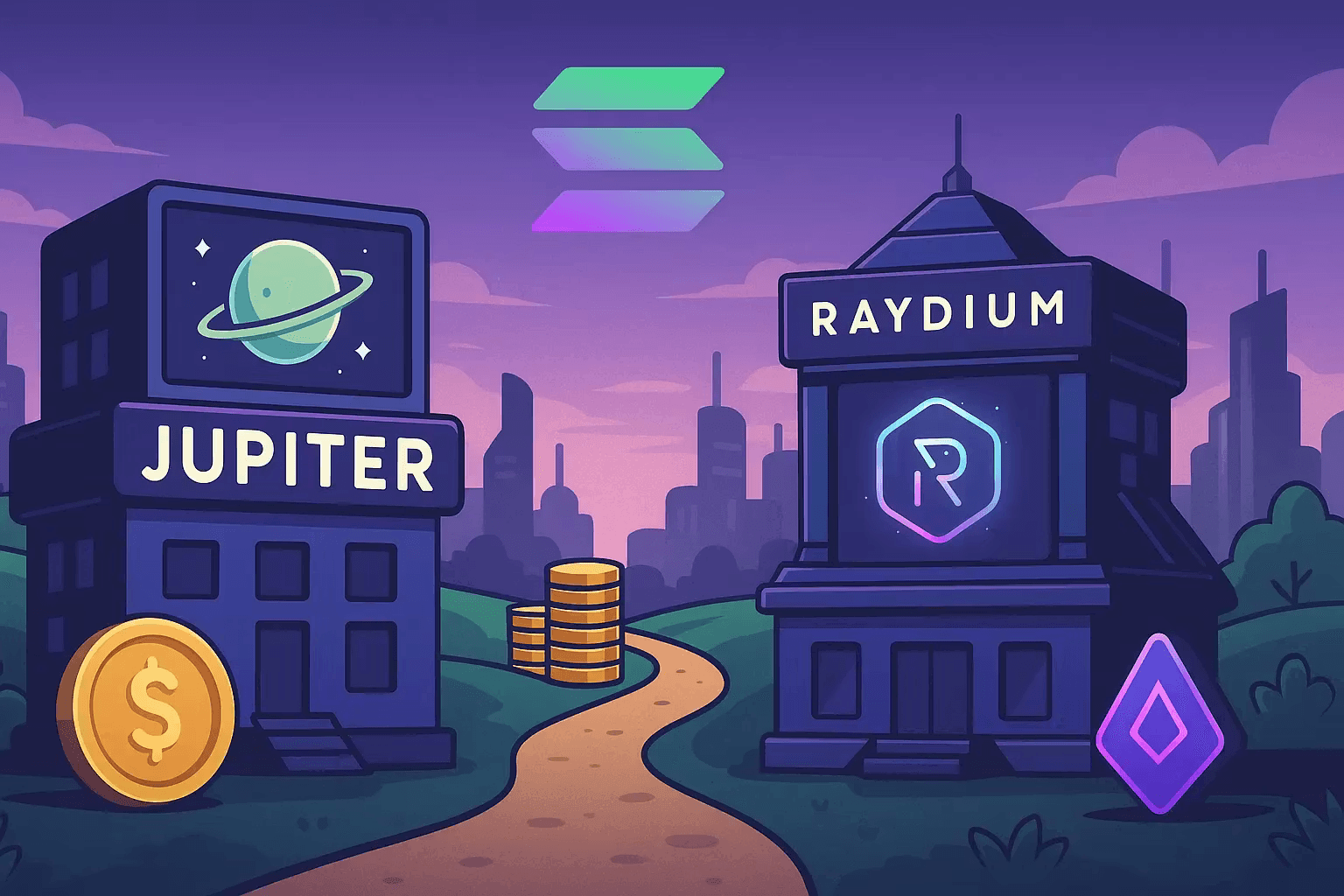
Most experienced Solana users use all three — Jupiter for swaps, Raydium for memecoin LP farming, and Orca for concentrated liquidity on stable pairs. They're complementary tools, not mutually exclusive. Jupiter actually routes through both Raydium and Orca pools, so when you swap on Jupiter, you're indirectly using them already.
How to Get Started
- Set up a Solana wallet. Phantom or Solflare are the most popular options. Both work seamlessly with all three DEXs.
- Fund your wallet with SOL from a centralized exchange (Coinbase, Binance, Kraken, etc.).
- Start with Jupiter for your first swaps — go to jup.ag, connect your wallet, and swap.
- Explore Raydium and Orca when you're ready to provide liquidity or need specific features.
Use Birdeye or DexScreener to research tokens and track prices across all three DEXs in one view.
Frequently Asked Questions
Is Jupiter better than Raydium?
They serve different purposes. Jupiter is a DEX aggregator — it finds the best price across all DEXs including Raydium. For swapping tokens, Jupiter is almost always the better choice because it checks every venue. Raydium is better for providing liquidity and accessing new token launches.
Does Jupiter use Raydium and Orca?
Yes. Jupiter routes trades through both Raydium and Orca pools (along with many others). When you swap on Jupiter, your trade might execute on Raydium, Orca, or split across both — whichever gives you the best price.
Which Solana DEX has the lowest fees?
Jupiter charges zero platform fees on swaps. The underlying pool fees vary: Raydium standard pools charge 0.25%, while Orca and Raydium CLMM pools range from 0.01% to 1% depending on the tier. For most trades, Jupiter finds the cheapest route automatically.
Can I provide liquidity on Jupiter?
No. Jupiter is purely a swap aggregator and does not run its own liquidity pools. To earn LP fees, use Raydium or Orca directly.
Which DEX is safest?
All three are established protocols with years of operation and audited smart contracts. The biggest risk in DeFi isn't the DEX itself — it's the tokens you trade. Always verify token contracts using tools like RugCheck before swapping, regardless of which DEX you use.
Where do Pump.fun tokens trade after bonding?
Since March 2025, Pump.fun tokens migrate to PumpSwap, Pump.fun's own DEX, after completing their bonding curve (~85 SOL raised); before that they migrated to Raydium, and some teams still add a Raydium pool later. Jupiter aggregates both venues, so you can trade these tokens from Jupiter once liquidity is established.
What is the best DEX for beginners on Solana?
Jupiter is the best starting point for beginners. It gives you access to every token on Solana with automatic best-price routing, requires no understanding of AMM mechanics, and charges no additional fees. Once you're comfortable with basic swaps, you can explore Raydium and Orca for LP features.
Explore all Solana DEXs and trading tools on MadeOnSol — your directory for discovering the best tools in the Solana ecosystem. Compare more tools side by side with our comparison tool.
September 2026 refresh
The product roles remain distinct: Raydium is a liquidity/AMM + LaunchLab venue, Jupiter is a routing/execution and broader trading stack, and Orca remains concentrated-liquidity focused. The old table's "Pump.fun migrations" under Raydium is historical: Pump.fun canonical graduations now go to PumpSwap. Also avoid ranking TVL/volume as static facts; those change continuously.
Jupiter's current architecture is broader than the old "aggregator only" label, while Raydium/Orca pool fees vary by pool configuration.