Every Solana trader has experienced it: you click swap, expecting to receive 10,000 tokens, and your wallet shows 9,400 instead. That 6% difference is slippage, and understanding how it works is the single most important skill for trading on decentralized exchanges. Whether you are swapping SOL for a blue-chip token on Jupiter or aping into a freshly launched memecoin on Raydium, slippage affects every trade you make.
This guide covers exactly what slippage is, why it happens on Solana specifically, how to configure it in every major tool, and the practical settings that will save you money across different trading scenarios.
What Is Slippage?
Slippage is the difference between the price you expect when you submit a trade and the price you actually receive when the trade executes on-chain. It can work in both directions — you might receive fewer tokens than expected (negative slippage) or occasionally more tokens than expected (positive slippage).
Here is a concrete example. You want to buy a memecoin trading at $0.001 per token. You submit a swap for 1 SOL (roughly $140) expecting to receive 140,000 tokens. By the time your transaction lands on-chain and executes, the price has shifted to $0.00105. You receive 133,333 tokens instead of 140,000. That is approximately 4.8% negative slippage.
On Solana, slippage is particularly relevant because transactions confirm in roughly 400 milliseconds. That sounds fast, but in a market where thousands of traders are buying the same token simultaneously — especially during a memecoin launch — prices can move dramatically within that window.
Your slippage tolerance setting tells the DEX smart contract: "Execute this trade only if the price has not moved more than X% from my quoted price. If it has, reject the transaction entirely." Set it too low and your transactions fail. Set it too high and you overpay or get exploited by MEV bots.
Why Slippage Happens on Solana
Slippage is not random. It is a direct consequence of how automated market makers (AMMs) work, combined with network conditions and adversarial actors. Here are the core causes.
AMM Mechanics and the Constant Product Formula
Most Solana DEXs — including Raydium and the liquidity sources Jupiter routes through — use AMM pools based on some variant of the constant product formula: x * y = k. When you buy token B with token A, you are adding token A to the pool and removing token B. The more you remove relative to the pool's total reserves, the more the price shifts against you.
A pool with $5 million in total liquidity can absorb a $1,000 trade with minimal price movement. That same $1,000 trade in a pool with $20,000 in liquidity will move the price dramatically. This is the single biggest driver of slippage on Solana. If the underlying mechanics here are new to you, our primer on how Solana liquidity, AMMs, pools, and order books work covers the foundations.
Low Liquidity (The Primary Culprit)
The Solana memecoin ecosystem is defined by low-liquidity tokens. A freshly launched Pump.fun token might have only $10,000-$30,000 in its bonding curve. A token that just graduated to PumpSwap might have $50,000-$100,000 in its initial liquidity pool. At these levels, even a 0.5 SOL buy ($70) can move the price by 1-3%.
Compare this to swapping SOL/USDC on a major pool with $50 million+ in liquidity, where a $10,000 trade barely registers. When your order is large enough to move even a deep pool, the fix is to route around the AMM entirely — see our guide to OTC trading for large Solana orders.
Network Congestion
Solana processes thousands of transactions per second, but during high-activity periods — major token launches, market-wide sell-offs, or NFT mints — transaction inclusion can slow down. The longer your transaction sits in the queue, the more the price can shift before execution. During peak congestion in late 2024 and throughout 2025, Solana experienced periods where transaction landing rates dropped significantly, increasing effective slippage for time-sensitive trades.
Concurrent Trading Pressure
When hundreds of traders simultaneously try to buy the same newly launched token, each successive trade executes at a slightly higher price than the last. Your quoted price was based on the pool state at the moment you requested the quote, but by the time your transaction executes, dozens of other buy orders may have already landed, pushing the price up.
MEV and Sandwich Attacks
Maximal Extractable Value (MEV) bots on Solana actively monitor the transaction mempool. When they see your pending swap, they can execute a sandwich attack: buying the token before your transaction (frontrunning), letting your trade execute at a worse price, then immediately selling for a profit (backrunning). This is covered in detail in a dedicated section below.
Slippage vs Price Impact — The Difference Most People Confuse
These two concepts are related but distinct, and confusing them costs traders money.
Price impact is the guaranteed price change your trade will cause based on the current pool state. It is deterministic and calculable before you trade. If you are buying $500 worth of a token from a pool with $10,000 in liquidity, your price impact might be 5%. This means the act of your trade alone moves the price by 5%, and you will receive 5% fewer tokens than the current spot price suggests. Price impact is shown on Jupiter and Raydium before you confirm a trade.
Slippage is the additional, unpredictable price movement that happens between when you submit your transaction and when it executes. It is caused by other trades landing before yours, network delays, or MEV activity.
Here is why this matters practically. You are buying a low-cap token. Jupiter shows: "Price impact: 3.2%." You set your slippage tolerance to 1%. Your transaction fails. Why? Because the 3.2% price impact already exceeds your 1% slippage tolerance once combined with even minimal market movement. You needed your slippage tolerance to be at least 3.2% just to account for your own trade's impact, plus additional buffer for market movement.
Many traders see a low slippage setting as "safe" without realizing that price impact and slippage compound. If a trade shows 4% price impact, you likely need at least 5-7% slippage tolerance to reliably execute.
Tools like Birdeye and DexScreener display liquidity depth for pools, which lets you estimate price impact before you even open a swap interface. Check these first.
How Slippage Settings Work
When you set a slippage tolerance of, say, 3% on Jupiter, you are instructing the swap program: "I expect to receive approximately X tokens. Execute this trade only if I receive at least X minus 3% tokens. If the output would be less than that minimum, revert the entire transaction."
This means:
- At 0.5% slippage: Your trade executes only if the price has moved less than 0.5% against you. Very tight — good for stable, liquid pairs, but will fail frequently on volatile tokens.
- At 5% slippage: Your trade tolerates up to 5% worse execution than quoted. Wider protection window — necessary for lower-liquidity tokens, but gives MEV bots more room to extract value.
- At 15%+ slippage: You are telling the contract you will accept dramatically worse pricing. Only appropriate for extremely low-liquidity tokens where you expect massive price impact and movement.
A failed transaction due to slippage tolerance being too low still costs you a small transaction fee (typically 0.000005 SOL on Solana). In periods of congestion with priority fees, failed transactions can cost 0.001-0.01 SOL each, which adds up fast if you are retrying repeatedly.
Recommended Slippage Settings by Scenario
There is no single correct slippage setting. It depends entirely on what you are trading.
Large-Cap Tokens (SOL, JUP, RAY, BONK, JTO): 0.3% - 1%
These tokens have deep liquidity across multiple pools. A $10,000 trade on SOL/USDC might have 0.01% price impact. Setting slippage to 0.5% gives you plenty of buffer while protecting against sandwich attacks. There is almost never a reason to go above 1% for these pairs.
Mid-Cap Established Tokens ($5M - $100M market cap): 1% - 3%
Tokens that have been trading for weeks or months with reasonable liquidity — think established memecoins that survived their launch phase, or newer DeFi tokens. Pools typically have $500K-$5M in liquidity. A 1-3% setting handles normal market volatility and moderate price impact without leaving excessive room for MEV extraction.
New Memecoins and Low Liquidity Tokens: 5% - 15%
Freshly launched tokens on Raydium, or tokens that recently graduated from Pump.fun bonding curves, often have $20K-$200K in liquidity. Price impact on even small trades can be 2-5%, and concurrent buying pressure during a trend can add another 5-10% movement. Settings of 5-15% are common, though you should be aware you are accepting significant execution risk.
Sniping New Launches on Pump.fun: 15% - 50%+
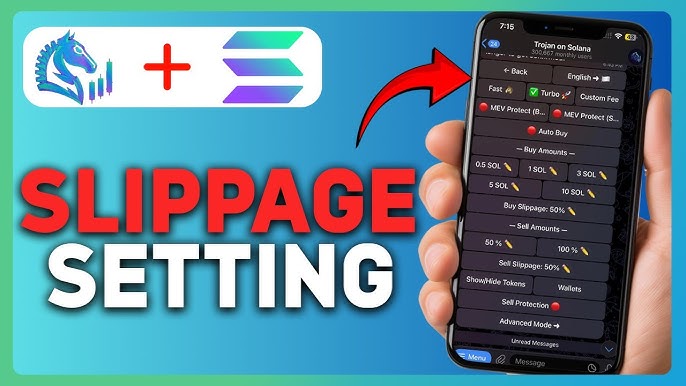
When a token first launches on Pump.fun and is still on its bonding curve, liquidity is extremely thin. The first few buyers face enormous price impact, and dozens of bots and manual traders are competing to buy simultaneously. Traders using tools like BullX, Photon, or Axiom for early entries often set slippage to 20-50% — accepting that execution quality will be poor in exchange for getting a position at all. Some Telegram bots like Trojan handle this by using fixed SOL amounts with high slippage rather than targeting specific token quantities.
Selling Positions: Add 1-2% Buffer
When selling tokens — especially memecoins — add a slightly higher slippage tolerance than you used to buy. If the token has a sell tax or transfer fee (some Solana tokens implement these), you need the extra buffer. A common frustration is being unable to sell a token because slippage is set too low for the token's built-in fee mechanics.
How to Minimize Slippage
Slippage is unavoidable on DEXs, but you can significantly reduce its impact with these strategies.
Check Liquidity Depth Before Trading
Before you swap, check the token's pool liquidity on Birdeye or DexScreener. Look for the total liquidity value in the trading pair. As a rough rule: if your trade size is more than 1-2% of the pool's total liquidity, expect noticeable price impact. If it is more than 5%, you will experience severe slippage.
For example, if a pool has $100,000 in liquidity and you want to buy $5,000 worth — that is 5% of the pool. Expect 5%+ price impact on top of any market slippage. Consider whether the trade is still worth it at that effective entry price.
Split Large Orders
Instead of swapping 10 SOL into a low-liquidity token in one transaction, split it into 3-4 smaller trades of 2.5 SOL each. Each individual trade has lower price impact, and if the price moves against you after the first few buys, you can stop. This is especially effective for tokens with $50K-$500K in liquidity.
The downside is higher total transaction fees and the risk that other buyers fill orders between your splits, but the net execution is usually better for trades above $500 in low-liquidity pools.
Jupiter offers limit orders that execute at your specified price or better. These eliminate slippage entirely — your order only fills if the price reaches your target. The tradeoff is that your order might never fill if the price moves away from your limit.
For non-urgent trades on established tokens, limit orders are strictly superior to market swaps. You set your price, walk away, and either get filled at your price or not at all.
Leverage Route Optimization
Jupiter aggregates liquidity from dozens of Solana DEXs, including Raydium, Orca, Meteora, and others. Its routing algorithm automatically splits your trade across multiple pools and DEXs to minimize price impact. A $5,000 trade that would cause 3% price impact on a single Raydium pool might only cause 0.8% impact when split across four pools by Jupiter's router.
Always use Jupiter (or a tool that routes through it) rather than swapping directly on a single DEX, unless you specifically need to interact with a particular pool.
Time Your Trades
Solana network congestion follows patterns. Major token launches, high-volatility market events, and peak US trading hours (roughly 14:00-22:00 UTC) tend to have higher congestion. If your trade is not time-sensitive, executing during lower-activity periods can improve transaction landing rates and reduce the chance of slippage from delayed execution.
Use Priority Fees Strategically
Higher priority fees increase the likelihood your transaction is included quickly, reducing the window for price movement. Most trading interfaces let you set priority fee levels. For time-sensitive trades on volatile tokens, a higher priority fee (0.001-0.01 SOL) often saves more in slippage than it costs in fees.