Solana Volume Bots Explained: How Fake Volume Works and How to Spot It (2026)
Learn how volume bots inflate Solana token trading volume, why projects use them, and how to identify fake volume before it costs you money.
MadeOnSol·· 9 min read
Disclosure: This article contains affiliate links. If you sign up through them, MadeOnSol may earn a commission at no extra cost to you. This never affects our rankings, ratings, or reviews.
Building a product on Solana or Robinhood Chain data?
Skip the Geyser pipeline — embed KOL flow, deployer reputation, and the all-DEX firehose over REST, WebSocket, or webhooks. The Business tier (€400/mo) is the self-serve embed license at 500k calls/day — Enterprise adds white-label & redistribution.
Some projects hire legitimate market makers who provide real two-sided liquidity. This is a normal practice even in traditional finance. The key difference is whether the volume represents real liquidity that other traders can actually access.
How Volume Bots Affect You as a Trader
Understanding volume bots matters because they can directly impact your trades:
False confidence: You might enter a position thinking there's strong demand, only to find the real volume is 10% of what's displayed.
Exit liquidity problems: When you try to sell, the "liquidity" created by bots vanishes because it was never real. Your market sell hits thin real liquidity and suffers massive slippage.
Trend chasing: Tokens trending on aggregators due to bot volume attract real traders, creating a temporary self-fulfilling prophecy — until the bots stop and the house of cards collapses.
The Regulatory Landscape
Wash trading is illegal in regulated financial markets. While crypto regulation remains fragmented, the direction of travel is clear. The SEC and CFTC have already brought enforcement actions against crypto wash trading on centralized exchanges.
On decentralized platforms, enforcement is harder, but that doesn't make the practice ethical or risk-free. As Solana matures and regulatory frameworks evolve, volume bot operators face increasing legal risk.
How to Protect Yourself
Here's a practical checklist before trading any token:
Check the volume-to-liquidity ratio on DEXScreener. Anything above 20:1 warrants suspicion.
Count holders on Solscan. Fewer than 100 holders on a "high volume" token is a warning sign.
Scan the trade history for repetitive patterns, identical amounts, and alternating buy-sell from the same wallets.
Tools mentioned
Compare features and read reviews.
Live health scores, average ratings, and direct links on MadeOnSol.
Building a product on Solana or Robinhood Chain data?
MadeOnSol isn't an RPC or another generic token API — it's Solana & Robinhood Chain memecoin intelligence that's painful to build in-house, pulled from dual-region gRPC shred streams and our own Robinhood Chain node, pushed to your app as events land.
Signals you'd otherwise build
KOL & smart-money flow from 2,000+ labeled wallets, deployer reputation, coordination clusters, linked-wallet entity resolution, and an all-DEX firehose.
Embed it in your product
The Business tier (€400/mo, self-serve) licenses you to display MadeOnSol data inside your own product — 500k calls/day, 15 WS + 6 firehose connections. Enterprise above adds white-label & redistribution rights and custom endpoints.
Evaluate first, commit later
Test everything on a free ULTRA key — no commitment. If it fits, we scope volume or white-label pricing.
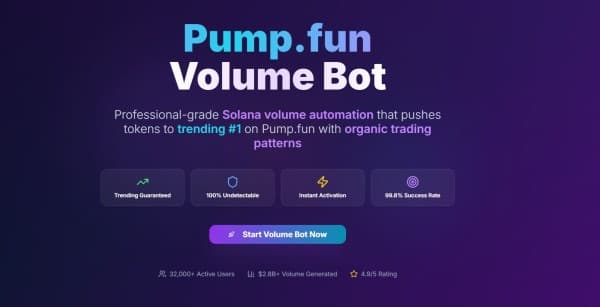
If you've spent any time trading on Solana, you've probably seen tokens with suspiciously high volume but barely any real holders. That's often the work of volume bots — automated programs designed to inflate trading activity and create the illusion of demand.
Understanding how volume bots work isn't just academic. It's a survival skill for anyone trading memecoins, participating in new launches, or evaluating tokens on Solana.
What Are Volume Bots?
Volume bots are automated scripts that execute repeated buy and sell transactions on a token, usually between wallets controlled by the same person or group. The goal is simple: make a token look more actively traded than it actually is.
This practice is commonly called wash trading. The bot buys and sells the same token back and forth, generating transaction volume without any real change in ownership. On aggregator sites like Birdeye and DEXScreener, this inflated volume makes the token appear popular and liquid.
Why Do Projects Use Volume Bots?
There are several reasons, ranging from somewhat understandable to outright malicious:
Trending rankings: DEX aggregators rank tokens partly by volume. Higher volume means more visibility, which attracts real traders.
Social proof: A token with $500K in 24h volume looks more legitimate than one with $2K. New traders often equate volume with validity.
Liquidity illusion: High volume suggests deep liquidity, encouraging larger trades. In reality, the liquidity pool may be thin.
Exchange listings: Some centralized exchanges require minimum volume thresholds. Bots can help tokens meet these requirements artificially.
Pre-rug inflation: In the worst cases, scammers use volume bots to attract buyers before pulling liquidity.
How Volume Bots Work on Solana
Solana's low transaction fees (fractions of a cent) and fast block times (~400ms) make it the ideal chain for volume botting. What would cost thousands in gas on Ethereum costs almost nothing on Solana.
The Basic Mechanism
Wallet cluster creation: The operator creates dozens or hundreds of wallets, funding each with small amounts of SOL.
Circular trading: Bot A buys the token from the pool, Bot B sells, Bot C buys — all controlled by the same operator. The tokens and SOL cycle between wallets.
Randomized patterns: Sophisticated bots vary trade sizes, timing, and wallet usage to mimic organic activity. Simple bots just repeat fixed amounts at regular intervals.
Fee management: Each trade incurs pool fees (usually 0.25-1%) and Solana transaction fees. The operator budgets for these as the "cost of marketing."
Cost of Running Volume Bots
Running a volume bot on Solana is remarkably cheap compared to other chains:
Transaction fees: ~$0.00025 per transaction (5000 lamports priority fee typical)
Pool fees: 0.25-1% per swap depending on the AMM
Daily cost for $100K fake volume: Roughly $250-$1,000 in pool fees plus negligible tx fees
This low cost is exactly why Solana has a more severe volume bot problem than most chains.
How to Spot Fake Volume
Identifying wash trading isn't always straightforward, but there are reliable signals. Here's what to look for.
1. Volume-to-Liquidity Ratio
This is the single most useful metric. If a token has $500K in daily volume but only $20K in liquidity, something is wrong. Organic tokens typically have volume-to-liquidity ratios between 1:1 and 10:1 for active tokens. Ratios above 20:1 are a red flag.
Check liquidity depth on Birdeye or DEXScreener and compare it to the reported volume.
2. Holder Count vs Volume
A token with $1M in daily volume but only 50 holders is almost certainly wash traded. Use Solscan to check the token's holder distribution. Real demand creates real holders.
3. Repetitive Trade Patterns
Open the trade history for the token on any DEX aggregator. Look for:
Trades at suspiciously regular intervals (every 30 seconds, every minute)
The same wallets appearing repeatedly in both buy and sell columns
Perfectly alternating buy-sell patterns
4. Wallet Cluster Analysis
This requires more effort but is the most definitive method. Pick several active trading wallets and trace their funding source on Solscan. If multiple wallets were all funded from the same parent wallet within a short time window, they're likely bot wallets.
Tools like GMGN can help visualize wallet connections and identify clusters.
5. Price Action Doesn't Match Volume
High volume usually creates price movement. If a token shows massive volume but the price barely moves (staying within a tight 1-2% range for hours), the volume is likely wash traded. Real buying pressure moves prices up; real selling pressure moves them down.
Watch what happens during off-peak hours. Organic volume fluctuates naturally — it's higher during US/EU market hours and lower overnight. Bot volume often maintains unnaturally consistent levels 24/7, or suddenly drops to near-zero when the operator turns off the bot.
Tools for Detecting Fake Volume
Several tools in the Solana ecosystem can help you evaluate whether volume is genuine:
RugCheck: Analyzes token risk factors including holder concentration and liquidity metrics that correlate with wash trading.
Birdeye: Provides detailed trade history, holder statistics, and liquidity data in one view. The "Trades" tab lets you spot repetitive patterns.
DEXScreener: Shows volume alongside market cap and liquidity. The charting tools help identify suspicious flat price action during high-volume periods.
Solscan: Essential for wallet analysis. Trace wallet funding sources and transaction histories to identify bot clusters.
Run a risk check on RugCheck for an automated assessment.
Watch the price chart. Real volume moves prices. Flat prices with high volume is a contradiction.
Wait before buying trending tokens. Give it 24-48 hours and see if volume persists organically after the initial pump.
Final Thoughts
Volume bots are one of the uncomfortable realities of trading on Solana — and on any low-fee blockchain. They exploit the openness of DeFi to create misleading signals that can cost uninformed traders real money.
The good news is that fake volume leaves traces. With the right tools and a skeptical eye, you can distinguish genuine trading activity from manufactured numbers. Make volume analysis part of your standard due diligence before entering any position, especially on newer or trending tokens.
The Solana ecosystem is building better detection tools every month. Until fake volume is fully addressed at the infrastructure level, your best defense is knowledge and discipline.
FAQ
Is using a volume bot illegal?
Wash trading is illegal in regulated financial markets in most jurisdictions, including the US. While enforcement on decentralized platforms is still evolving, operating or hiring volume bots carries increasing legal risk as crypto regulation matures.
How much does it cost to run a volume bot on Solana?
Due to Solana's low fees, generating $100K in fake daily volume typically costs between $250-$1,000 per day in AMM pool fees, plus negligible transaction fees. This low cost is why Solana sees more volume botting than higher-fee chains.
Some aggregators are working on wash trading detection algorithms, but it remains an arms race. Sophisticated bots randomize their patterns to evade detection. For now, manual analysis using the methods described in this article remains the most reliable approach.
Does fake volume ever become real volume?
Sometimes. If bot-driven visibility attracts enough genuine traders, a token can develop organic volume that outlasts the bots. However, this is essentially a form of marketing fraud — using fake data to attract real customers — and the organic volume often disappears once the artificial activity stops.
Where can I learn more about spotting bots beyond the volume metric itself?