Solana is one of the fastest blockchains in production, but the headline numbers you see on Twitter rarely tell the full story. "65,000 TPS" does not mean what most people think it means. Validator counts without context about stake distribution are meaningless. And uptime statistics are more nuanced than "100% or not."
This guide breaks down every major Solana network metric — what it measures, how to interpret it correctly, and where to find reliable data. Whether you are evaluating Solana as an investor, a developer choosing where to build, or a validator assessing the network, this is the reference you need.
Transactions Per Second (TPS)
TPS is the most cited and most misunderstood Solana metric.
Theoretical vs. Actual TPS
Theoretical maximum: Solana's architecture was designed to handle up to 65,000 TPS. This number comes from the theoretical throughput of the Turbine block propagation protocol combined with Sealevel parallel transaction execution.
Actual TPS: In practice, Solana processes between 2,000 and 5,000 transactions per second during normal network operation. During peak demand (major mints, memecoin launches, market crashes), this can spike higher.
Why the gap exists:
- The theoretical max assumes all transactions are perfectly parallelizable. Real transactions often touch the same accounts, forcing sequential processing.
- Network consensus overhead consumes bandwidth.
- Validators have varying hardware capabilities, and the network runs at the speed of the majority, not the fastest nodes.
- Transaction scheduling and prioritization add latency.
Vote Transactions vs. User Transactions
This is the single most important distinction when evaluating Solana TPS.
Vote transactions are internal consensus messages where validators vote on the validity of blocks. They make up a significant portion of total Solana transactions — often 60-80% during normal periods.
Non-vote transactions are actual user activity: token swaps, NFT trades, transfers, DeFi interactions. This is the metric that reflects real demand for Solana blockspace.
When someone claims "Solana is doing 4,000 TPS," ask whether that includes vote transactions. The actual user TPS is typically 800-2,000 during normal operation, which is still faster than virtually every other L1 blockchain, but it is important to compare apples to apples.
Where to Track TPS
| Tool | What It Shows | Best For |
|---|
| Solana Explorer | Real-time TPS with vote/non-vote split | Quick current snapshot |
| Solanabeach | Historical TPS trends, cluster stats | Trend analysis |
| Chainspect | Cross-chain TPS comparison | Comparing Solana to other L1s |
Validators
Validators are the backbone of Solana's proof-of-stake consensus. They produce blocks, vote on consensus, and secure the network. Understanding validator metrics tells you about Solana's security and decentralization.
Validator Count
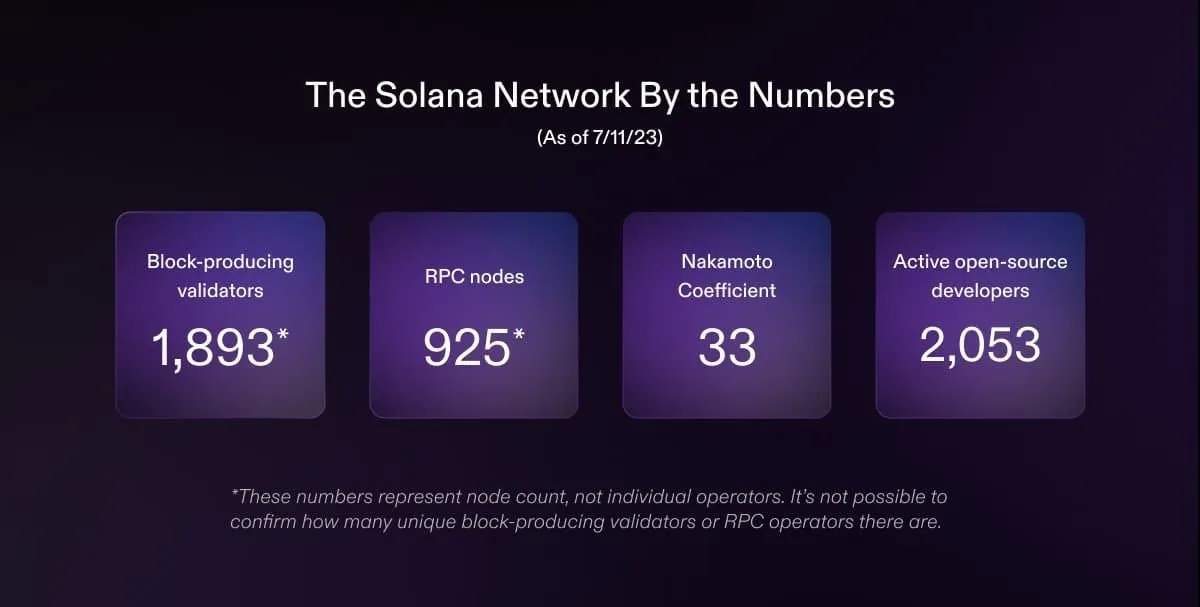
Validator count has fallen sharply during 2026 as rising node costs squeezed out smaller operators — from roughly 1,400-1,600 active validators on mainnet-beta in early 2026 down to around 900 by mid-2026, with several thousand additional RPC nodes that do not participate in consensus.
How to interpret validator count:
- More validators = more decentralization — A higher validator count makes it harder for any coalition to censor transactions or halt the network.
- Quality over quantity — 100 validators each running on dedicated hardware in unique data centers is more resilient than 1,000 validators running on the same three cloud providers.
- Active vs. delinquent — Not all validators are performing well. Delinquent validators are not participating in consensus and should be excluded from count metrics.
The Nakamoto Coefficient
The Nakamoto coefficient measures the minimum number of validators that would need to collude to compromise the network (halt it or censor transactions). For Solana, this requires controlling 33.3% of the total stake.
Current state: Solana's Nakamoto coefficient improved through early 2026 but has since slipped alongside the validator count decline, sitting around 19-20 by mid-2026. This means approximately 19-20 of the largest validators would need to collude to halt the network.
For context:
- Bitcoin's Nakamoto coefficient (mining pools): ~4-5
- Ethereum's Nakamoto coefficient (staking): ~5-8
- Solana's Nakamoto coefficient: ~19-20
Solana still performs well on this metric relative to other major chains, though the recent decline is a real centralization concern, and the comparison is imperfect because the security models differ fundamentally.
Stake Distribution
Stake distribution shows how SOL is allocated across validators. A healthy distribution means stake is spread across many validators rather than concentrated in a few.
Key metrics to watch:
- Superminority — The smallest set of validators controlling 33.3%+ of stake. Fewer validators in the superminority = more stake concentration (worse for decentralization).
- Top 10 validator stake share — What percentage of total stake do the 10 largest validators hold? Lower is better.
- Long tail — How many validators have meaningful stake (enough to produce blocks regularly)? A long tail of validators with trivial stake does not meaningfully contribute to security.
Where to track: StakeWiz provides the most detailed stake distribution analysis for Solana, including historical trends, concentration metrics, and individual validator performance.
Validator Performance Metrics
When choosing a validator to stake with or assessing network health, these metrics matter:
Skip rate: The percentage of assigned leader slots where a validator fails to produce a block. A skip rate under 5% is good. Above 10% suggests performance issues. Network-wide average skip rate indicates overall network health.
Vote credits: The number of successful votes a validator submits per epoch. Higher vote credits generally mean better performance and more rewards for stakers. Compare against the cluster average.
Commission rate: The percentage of staking rewards the validator keeps. Most Solana validators charge 5-10% commission. Lower is not always better — validators with 0% commission may not be sustainable long-term.
Uptime: What percentage of epochs has the validator been active? Look for 99%+ uptime over extended periods, not just the current epoch.
Data center concentration: Check where the validator runs. If too many validators run in the same data center (e.g., all on Hetzner in Germany), a single data center outage could affect a large portion of stake.
Block Times
Solana targets a block time of 400 milliseconds, which is dramatically faster than Ethereum's 12 seconds or Bitcoin's 10 minutes.
How Block Production Works
Solana uses a leader-based block production model:
- The leader schedule is predetermined for each epoch (roughly 2-3 days). Every validator knows which validator will be the leader for each slot.
- During their assigned slots, the leader collects transactions, creates a block, and distributes it to the network via Turbine.
- Other validators vote on the block's validity.
- After enough votes, the block is confirmed and eventually finalized.
Slot Time vs. Block Time vs. Finality
These are different things and get confused constantly:
- Slot time (~400ms): The target duration of each slot. Not every slot produces a block (some are skipped).
- Block time: The actual time between produced blocks. Because of skipped slots, the effective block time is slightly higher than 400ms.
- Confirmation time (~5 seconds): The time until a transaction reaches "confirmed" status (voted on by a supermajority).
- Finality time (~12-13 seconds): The time until a transaction is finalized (rooted) and cannot be reverted. This is the security-relevant metric.
For practical purposes, most applications treat "confirmed" as sufficient. Finalized transactions provide maximum security but take longer.
Monitoring Block Production
Solana Explorer shows real-time block production including:
- Current slot and block height
- Recent block times
- Skip rates for the current epoch
- Leader schedule for upcoming slots