
What Is Jito MEV on Solana? Bundles, Tips & 5-TX Max Explained
Jito block engine lets searchers submit 5-tx bundles with tips. How MEV works on Solana, why bundles cap at 5, and how to send your first via REST.
MadeOnSol··Updated · 10 min read
Jito block engine lets searchers submit 5-tx bundles with tips. How MEV works on Solana, why bundles cap at 5, and how to send your first via REST.
While Jito creates a structured priority system, sandwich attacks still exist on Solana. Here's how they work specifically on Solana:
Use MEV-protected RPCs: Some RPC providers route transactions through private channels that bots can't observe. Jupiter has built-in MEV protection
Set slippage carefully: Lower slippage tolerance (1-3% for liquid tokens) limits how much value a sandwich can extract. If the sandwich would push your price beyond your slippage limit, your transaction reverts instead of executing at a bad price
Use limit orders: Sandwich attacks only work on market orders. Limit orders execute at your specified price or not at all — there's nothing to sandwich
Split large orders: Instead of swapping 100 SOL at once, split into several smaller swaps. Smaller transactions are less attractive for sandwich bots (less profit to extract)
Use trading tools with built-in protection: Most Solana trading platforms now include anti-MEV features. Jupiter's default routing includes MEV protection, and tools like Photon and BullX have protection settings
Jito isn't just MEV infrastructure — it also runs one of Solana's largest liquid staking protocols.
When you stake SOL with Jito, you receive JitoSOL — a liquid staking token that represents your staked SOL plus accumulated rewards.
This makes JitoSOL one of the highest-yielding liquid staking tokens on Solana.
Tools mentioned
Live health scores, average ratings, and direct links on MadeOnSol.

Liquid staking and MEV protocol powering Solana validators

Ultra-fast Solana trading terminal with MEV-protected execution

Real-time token data API and analytics for Solana traders

Open-source DeFi analytics dashboard tracking TVL, yields, and protocol metrics across Solana

DeFi ecosystem directory with curated Solana project listings and analytics
Access Solana DeFi data via API
KOL trading intelligence, DEX trade streaming, and deployer analytics. Free tier: 200 requests/day.
from madeonsol_x402 import MadeOnSolClient

client = MadeOnSolClient(api_key="msk_your_key")

# KOL convergence signals — what are whales accumulating?
signals = client.kol_coordination(period="24h", min_kols=3)

# KOL PnL leaderboard
leaders = client.kol_leaderboard(period="7d")Keep reading
Trading
Learn how MEV works on Solana, what sandwich attacks and front-running actually cost you, and practical strategies to protect your trades using Jito tips, priority fees, private transactions, and slippage settings.

Guides
The best Solana liquid staking tokens in 2026 — JitoSOL, mSOL, JupSOL, bSOL and INF compared on APY, MEV, DeFi support and risk — plus how to launch your own white-label LST. Find the right LST for your strategy.
Guides
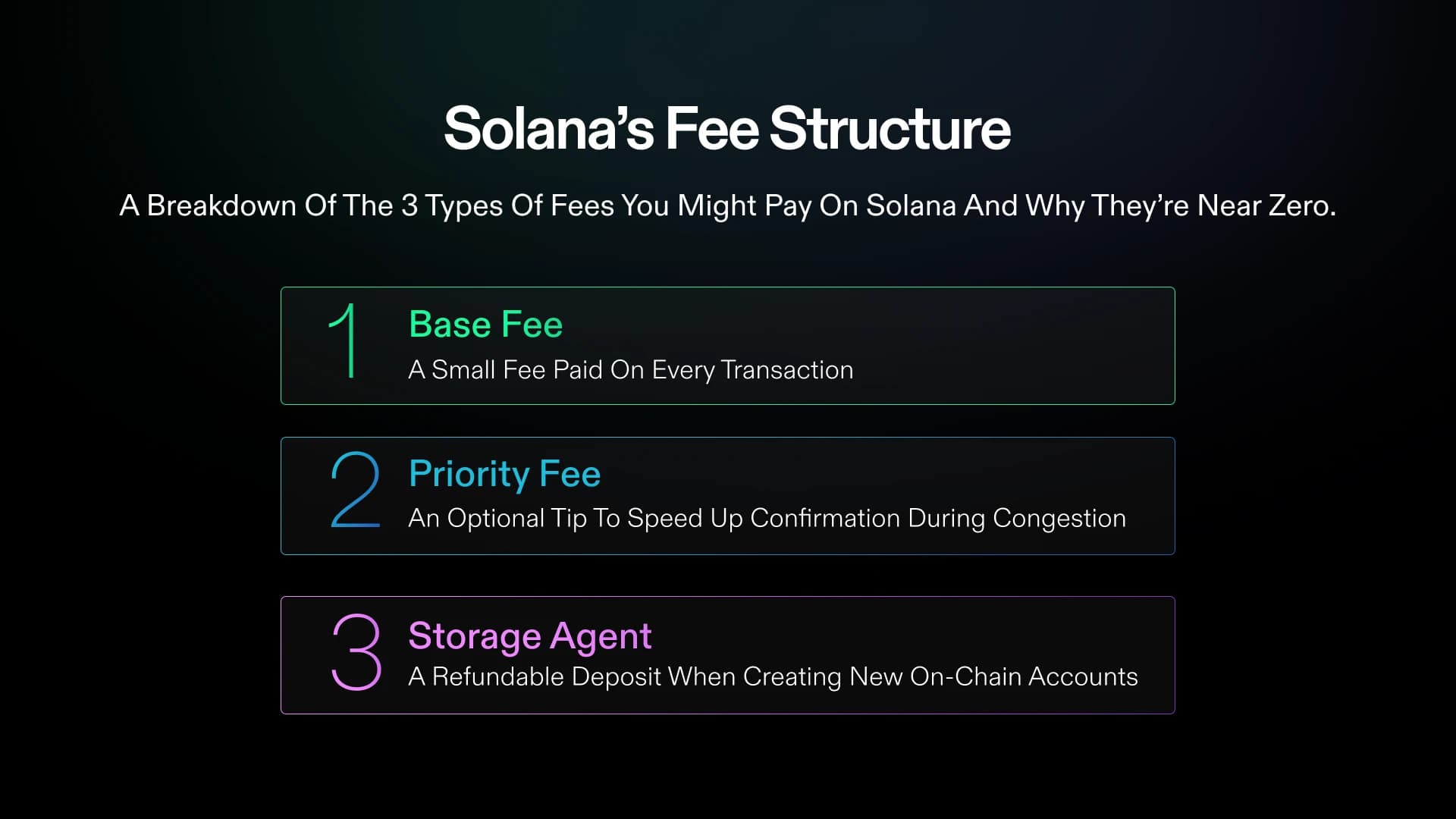
Everything you need to know about Solana transaction fees in 2026. Understand base fees, priority fees, Jito tips, compute units, and practical strategies to reduce costs without sacrificing speed.

Trading
Solana has no traditional mempool, but pending transactions are still observable. Learn how Solana mempool monitoring works with Jito bundles, gRPC streams, leader TPU forwarding, and ShredStream — plus practical tools and use cases for MEV detection, frontrun protection, and latency optimization.

Trading
Understand how Solana transaction bundling works, why token launches use bundle buys on Pump.fun, and how to detect bundled tokens as a trader.
DeFi
A tiered guide to earning yield on Solana in 2026. Covers conservative strategies (staking, lending), moderate approaches (LP, liquid staking), and aggressive plays (leveraged LP, yield looping) with realistic APY ranges and risk levels.
Enjoyed this article?
Real-time KOL trades, Pump.fun deployer intel, and 1,200+ ranked Solana & Robinhood Chain tools — free to explore.
Open the KOL TrackerIf you've traded on Solana, you've seen the "Jito tip" or "priority fee" setting in your trading tool. You probably adjusted it once, picked a number that felt right, and never thought about it again.
But understanding what Jito does and why MEV matters can save you money, improve your execution, and prevent you from getting silently exploited on your trades. This guide explains it all from the ground up — no prior knowledge needed.
MEV stands for Maximal Extractable Value. It refers to the profit that can be made by reordering, inserting, or censoring transactions within a block before it gets finalized on the blockchain.
In simpler terms: someone who controls transaction ordering can extract money from your trades.
Here's a concrete example:
This is called a sandwich attack, and it's the most common form of MEV that affects regular traders. The bot literally sandwiches your transaction between their buy and sell, extracting value from the price impact.
Solana handles transactions differently from Ethereum. On Ethereum, there's a visible mempool where pending transactions queue up. Bots scan this mempool to find profitable MEV opportunities.
Solana doesn't have a traditional public mempool. Transactions go directly to the current block leader (validator). In theory, this makes MEV harder to extract because transactions aren't publicly visible before inclusion.
In practice, MEV still happens on Solana through several mechanisms:
This is where Jito comes in.
Jito started as an MEV infrastructure protocol for Solana. It created a structured system for handling transaction priority, replacing the chaotic spam-based approach with an auction-based model.
Jito's core innovation: bundles with tips.
Instead of submitting a single transaction and hoping it gets included, Jito allows users and bots to submit bundles — groups of transactions that must be executed together, in order, or not at all.
Each bundle includes a tip — a payment to the validator for including the bundle with priority.
The flow:
This creates a clean market for transaction priority. Instead of spamming the network, participants bid for inclusion. Higher tips = better positioning in the block.
You don't need to understand the technical details. What matters is this:
Jito tips help your transactions land faster and protect against some forms of MEV.
When you set a Jito tip on your swap:
You'll see both terms in trading tools. They're related but different:
Priority fees (also called "compute unit price") are Solana's native mechanism. You pay extra to the validator via the protocol's built-in priority system. These are denominated in micro-lamports per compute unit.
Jito tips are an additional payment specifically to Jito validators, submitted as a separate transfer within your bundle. These are denominated in SOL (usually small amounts like 0.001-0.01 SOL).
Most trading tools combine both: they set a priority fee AND include a Jito tip for maximum transaction landing probability.
Every major Solana trading tool has Jito tip settings:
For normal swaps (not time-sensitive):
For competitive buys (new launches, trending tokens):
For sniping (buying at token launch):
The golden rule: Only tip more than you're willing to lose. If you're buying $10 worth of a memecoin, a $5 Jito tip doesn't make sense.
You can use JitoSOL across Solana DeFi — as collateral for borrowing, in liquidity pools, or just hold it for passive yield. When you want to unstake, you can either use the standard unstaking flow (takes a few days) or swap JitoSOL → SOL on Jupiter for instant liquidity.
Both are quality liquid staking tokens:
Many DeFi users hold both for diversification.
Jito also has a governance token, JTO, which was airdropped in December 2023. JTO holders can:
JTO is separate from JitoSOL. You don't need JTO to use Jito's MEV infrastructure or liquid staking.
No. For non-time-sensitive transactions (sending SOL to a friend, staking, claiming rewards), standard priority fees are fine. Jito tips matter most for competitive scenarios: trading, sniping, and anything where transaction speed affects your outcome.
Jupiter has built-in MEV protection that routes transactions through protected pathways. While no system is 100% sandwich-proof, Jupiter's protection significantly reduces the risk compared to raw RPC submissions.
Tips increase your priority but don't guarantee inclusion. During extreme congestion (thousands of people buying the same token simultaneously), some transactions will still fail. The tip determines your priority relative to other tippers — if thousands of people all tip high, some will still miss out.
No. Jito tips are only paid if your bundle successfully executes. If the transaction fails or reverts, you don't pay the tip (you still pay the base transaction fee).
Validators receive a share of Jito tips, with the rest going to JitoSOL stakers. The exact split is governed by the protocol. Jito-enabled validators earn significantly more than non-Jito validators, which is why the vast majority of Solana validators now run Jito.
MEV is a reality of blockchain trading. On Solana, Jito has turned what was once a chaotic spam-based problem into a structured priority market. As a trader, you benefit from:
The key takeaway: set your priority fees appropriately for the situation (low for routine transactions, high for competitive trades), use slippage protection, and consider JitoSOL for your staked SOL to capture MEV rewards rather than losing to them.
Learn more about Solana's DeFi ecosystem and find the right tools for your trading strategy at MadeOnSol. Read our Solana transaction fees explainer for more on how fees work.