
All plans; fields and availability vary by route · Compare plans and subscribe
Interpret token amounts, timestamps and data quality correctly
Handle MadeOnSol token precision, timestamps, null values and module quality without confusing missing information with zero.
By MadeOnSol · Updated
Integration choice
Preserve the meaning of each response before formatting it. Keep raw amounts, decimal scale, source timestamps and quality metadata distinct. Use the endpoint contract for units and availability; do not infer one universal shape from a different route or chain.
Before you start
- The reference contract for each route and channel you consume.
- Fixtures that include missing and partial values, not only a happy-path response.
Implementation steps
- Build a small adapter for each response type. Validate required fields and preserve documented status, reason, as_of and provenance fields when present.
- Keep integer amounts as strings or BigInt until display. Use the documented decimals for that token and field, not a fixed assumption across all tokens.
- Record event or source time separately from local receipt time. Convert timestamps according to the documented field unit; do not guess by string length.
- Represent unavailable, empty and zero as separate application states. Retain an older valid value according to your freshness policy instead of manufacturing a new zero.
- Merge state using documented identity and ordering rules. Merge candles by chain, token and bucket start, replacing revisions in the existing bucket.
Keep precision until the display boundary
JavaScript Number cannot exactly represent every large integer. When a contract returns a raw integer string, preserve it and apply its decimal scale with integer arithmetic or a decimal library. The example formats a raw amount without a floating-point conversion.
Do not apply token decimals to an already normalized decimal amount. Prices, token quantities, fiat values and percentages have different units. The example is for raw non-negative integers only; it is not a universal parser for every MadeOnSol numeric field.
Separate availability from freshness
The intelligence helper preserves per-module status, reason, as_of and provenance rather than treating every module as equally current. A response can contain useful data in one module and incomplete information in another. Handle each module according to its contract.
Robinhood Chain price state includes quality and quality_reason. A recent network receipt does not turn a stale or unreliable source price into a fresh one. Similarly, a holder count of null for an unindexed token is not evidence that the token has zero holders.
Use the right timestamp and identity
Keep chain in every token and event key. Do not lowercase Solana addresses; Robinhood Chain hexadecimal addresses can be normalized according to their contract. Preserve the original event identity alongside any display-friendly fields.
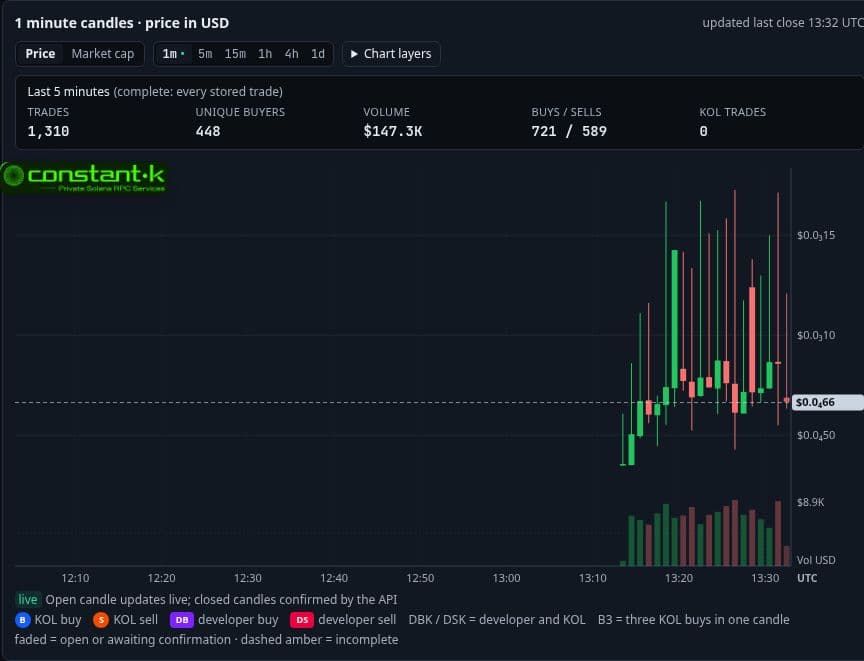
A candle’s bucket time describes the interval it aggregates, not necessarily the time your application received it. Replace a closed or revised bucket by its identity rather than appending duplicate rows. Repainting a current state and reconstructing historical events remain different operations.
Code examples
Format a raw token amount (standalone JavaScript)
// For a documented RAW non-negative integer amount only.
// Already normalized decimal fields must not be scaled again.
function formatRawAmount(raw, decimals) {
  if (typeof raw !== "string" || !/^\d+$/.test(raw)) throw new Error("Expected an integer string");
  if (!Number.isInteger(decimals) || decimals < 0 || decimals > 255) throw new Error("Invalid decimals");
  const digits = BigInt(raw).toString();
  if (decimals === 0) return digits;
  const padded = digits.padStart(decimals + 1, "0");
  return padded.slice(0, -decimals) + "." + padded.slice(-decimals);
}
console.log(formatRawAmount("9007199254740993123", 9)); // 9007199254.740993123
console.log(formatRawAmount("0", 6)); // 0.000000
Common mistakes and fixes
| Mistake | Recommended fix |
|---|---|
| Render null as 0 everywhere. | Use an explicit unavailable state; zero is a measured value. |
| Convert a raw amount to Number before scaling. | Keep the integer exact until formatting. |
| Use receipt time as source freshness. | Store both times and apply the route’s quality metadata. |
Verify your integration
Use fixtures with a genuine zero, null, an empty list, a large integer amount, differing token decimals, an older source timestamp and a revised candle. Confirm these remain distinguishable and that formatting never changes the original stored value.
Production checklist
- Raw payloads mapped by endpoint-specific adapters.
- Large amounts retain exact digits.
- Unknown, empty and zero covered by fixtures.
- Source freshness preserved through caching and rendering.
Frequently asked questions
Is a recently fetched response necessarily fresh market data?
No. Request time and source time measure different things. Inspect the source timestamp and quality fields where the contract supplies them.
Can I assume every token uses nine decimals?
No. Use the token and field’s documented scale. Some fields are already normalized and must not be scaled again.