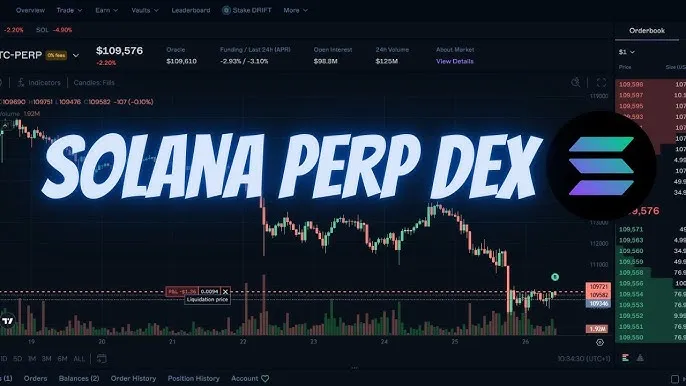
Perpetual futures dominate crypto trading volume. On centralized exchanges, perps consistently outpace spot markets by 3-5x. But the trend is shifting on-chain — and Solana has become the most competitive battleground for decentralized perpetual trading.
This article preserves four major Solana perp names from the original comparison, but three have materially changed status by September 2026: Drift Protocol (historical/recovery), Zeta Markets, Flash Trade, and Jupiter Perps. Each takes a different approach to on-chain leverage trading, and the right choice depends on what you're optimizing for — fees, leverage, available markets, or simplicity.
This guide compares all four across every metric that matters.
Quick Comparison Table
| Venue | September 2026 status | What the old comparison represented | Use for new positions today? |
|---|
| Drift | Recovery / full protocol reboot; relaunch planned, no current public relaunch announcement on Drift's updates page | Orderbook/hybrid Solana perps + broader DeFi suite | No — wait for official relaunch |
| Zeta Markets | Ceased operations May 2025; Bullet is a new successor project/network | Solana CLOB perps venue | No |
| Flash Trade | Orderly wind-down since Aug 31, 2026; positions force-closed Sept 2 | Oracle/pool-based perps with high leverage | No |
| Jupiter Perps | Active | Oracle/JLP-based perps integrated into Jupiter | Yes; current max leverage up to 250x on SOL/ETH/wBTC |
The detailed sections below preserve how Drift, Zeta and Flash worked because people still search for those products and because the architectural comparison is useful. Their old fees, leverage and market counts are historical, not current offers.
How Perpetual DEXs Work on Solana
Before diving into each protocol, it helps to understand the two main architectures used by Solana perp DEXs:
Orderbook Model (Drift, Zeta)
Orderbook-based protocols match buyers with sellers directly. Makers place limit orders that provide liquidity, and takers fill those orders. This model typically offers tighter spreads and better price discovery, but requires active market makers to maintain liquidity. If you're curious about being on the supply side of that equation, our introduction to market making on Solana walks through how it works and how to start.
Drift uses a hybrid model it calls DLOB (Decentralized Limit Order Book), where orders are matched by keeper bots off-chain and settled on-chain. Zeta runs a fully on-chain CLOB (Central Limit Order Book).
Oracle-Based Pool Model (Flash Trade, Jupiter Perps)
Pool-based protocols let traders trade against a liquidity pool rather than individual counterparties. Prices come directly from oracle feeds (Pyth Network), meaning zero price impact on trades. Liquidity providers deposit assets into the pool and earn fees from trader activity.
The trade-off: LPs take the other side of every trade, so they profit when traders lose and lose when traders win. This creates a natural tension that keeps the system balanced over time.
Drift Protocol (historical/recovery): The Full-Featured Veteran
Drift was a major Solana perps venue before the April 2026 exploit. It is currently in recovery/rebuild mode and is not a public live trading choice. The team says the relaunch will be a security-first, USDT-settled perps exchange.
What Drift Does Well
Market depth and variety. Drift offers 30+ perpetual markets spanning major crypto assets (BTC, ETH, SOL), mid-caps, and even some memecoins. If you want exposure to a wide range of assets with leverage, Drift is your best bet.
Advanced order types. Beyond basic market and limit orders, Drift supports stop-loss, take-profit, trailing stops, and TWAP orders. For serious traders, these tools are essential for managing risk across multiple positions.
Composable DeFi. Drift isn't just a perps exchange. It offers spot trading, borrow/lend markets, insurance fund staking, and managed vaults. Your collateral can earn yield while backing your positions, improving capital efficiency.
Fee tiers. High-volume traders benefit from Drift's tiered fee structure. Makers can earn rebates at higher tiers, and taker fees decrease with volume. If you're doing significant volume, Drift rewards you for it.
Where Drift Falls Short
Historically, Drift's 20x cap was lower than Flash Trade's old 100x offer. Jupiter Perps now advertises up to 250x on selected SOL/ETH/wBTC markets. Because Drift is rebuilding and Flash is winding down, this is historical product context rather than a live leverage comparison.
The interface, while powerful, has a learning curve. New traders may find the number of options overwhelming compared to simpler platforms like Jupiter Perps.
Best For
Historical fit only. This described Drift before the April 2026 exploit. The old Drift deployment is not a live venue choice; evaluate the current Drift relaunch deployment and other active perp venues separately.
Zeta Markets — Historical (Ceased May 2025)
Zeta Markets ceased operating in May 2025. The section below describes the discontinued venue for historical comparison. Zeta's docs identify Bullet as a new trading network/project that extends parts of Zeta's work; Bullet is not the old Zeta exchange continuing under a simple rename.
What Zeta Does Well
Execution speed. Zeta's architecture is optimized for fast fills. The on-chain orderbook means trades settle in a single Solana transaction, and the protocol has invested heavily in reducing latency. For scalpers and short-term traders, speed matters.
Clean interface. Zeta's trading UI is streamlined and focused. The charting is solid, the order entry is fast, and there's less clutter than Drift's multi-product interface. If you just want to trade perps without distractions, Zeta delivers.
Competitive fees. Zeta's maker/taker fee structure is competitive with Drift, and high-volume traders can access significant discounts. The ZEX token provides additional fee reductions when staked.
Cross-margin. Zeta supports cross-margin mode, where your entire account balance serves as collateral for all positions. This improves capital efficiency and reduces the risk of individual position liquidations.
Where Zeta Falls Short
The market selection, while growing, is narrower than Drift's. If you want to trade perps on smaller-cap tokens, your options are more limited.
Zeta's ecosystem features beyond perps trading are less developed. There's no integrated lending market or managed vaults like Drift offers. Zeta does, however, support options alongside perps — our dedicated Zeta Markets guide covers both products in depth.
Best For
Historical research only. Zeta is not available for new trading.
Flash Trade — Historical / Wind-Down
Flash Trade entered an orderly wind-down in August 2026. New positions/deposits moved to close-only on August 31 and remaining positions were scheduled for force-close on September 2. The section below describes the product before wind-down; it is not a current venue recommendation.
What Flash Trade Does Well
100x leverage. This is Flash Trade's headline feature. For traders who want maximum capital efficiency, 100x leverage on BTC and ETH perps opens up strategies that aren't possible on 20x platforms. A $100 position with 100x leverage gives you $10,000 in exposure.
Zero price impact. Because Flash Trade uses oracle prices rather than an orderbook, your trade size doesn't move the price. Whether you're opening a $100 or $100,000 position, you get the same price. This is a major advantage for larger trades.
Simple fee structure. Flash Trade charges a flat fee per trade rather than a complex tier system. This is transparent and easy to understand — you know exactly what you're paying before you confirm.
LP yield. Liquidity providers earn a share of all trading fees, funding rate payments, and trader losses. In periods of high trading activity, LP yields can be attractive.
Where Flash Trade Falls Short
High leverage cuts both ways. At 100x, a 1% move against your position means a 100% loss — instant liquidation. The protocol attracts traders who use aggressive leverage, and the liquidation rate reflects this.
The market selection is the smallest on this list, focusing primarily on major pairs. If you want to trade perps on anything beyond BTC, ETH, SOL, and a handful of others, Flash Trade doesn't support it yet.
No maker rebates. The pool-based model means there's no concept of makers and takers. You can't earn fees by providing limit order liquidity like you can on Drift or Zeta.
Best For
Historical research only. Flash Trade is winding down and should not be used for new positions.