
MadeOnSolMade on Sol

Data APIs

Solana Data APIRobinhood Chain API

Intelligence

Telegram AlertsKOL TrackerWallet ScannerToken LookupDeployer Hunter
Trading BotsTrading TerminalsWallet TrackingToken Scanners
View all solutions
Optimization guidesAPI DocsWebSocket StreamingMCP & SDKsx402 for AI AgentsAgent Intelligence Gateway
Discover ToolsCompare ToolsSubmit a ToolAdvertiseBlog
Pricing
Get real-time feedsSign in
MadeOnSolMade on Sol

Solana and Robinhood Chain intelligence — KOL wallet tracking, deployer intelligence, all-DEX trade streams, and a developer API. Discover, compare, and build.

Product

  • Solana Data API
  • Solana Wallet Checker
  • Robinhood Chain Wallet Checker
  • Robinhood Chain API
  • Robinhood Chain x402
  • MCP Servers & SDKs
  • x402 for AI Agents
  • Agent Intelligence Gateway
  • Pricing
  • Enterprise / For Businesses

Solutions

  • Trading Bots
  • Wallet Tracking
  • Copy Trading
  • Token Scanners
  • Trading Terminals
  • DEX Data
  • Smart Money
  • Token Risk
  • AI Agents
  • ShredPrism Stream
  • View all solutions

Developers

  • Optimization guides
  • API Docs
  • WebSocket Streaming
  • Changelog
  • API Status
  • Latency Benchmarks
  • Data Integrity
  • Data Dictionary
  • Methodology

Resources

  • All Tools
  • Compare Tools
  • Best Trading Bots
  • Best DEXs
  • Best Wallets
  • Best Analytics
  • Best DeFi
  • Best Snipers
  • Blog
  • Blog Archive
  • Signal Scorecard
  • Tool Uptime
  • Community
  • Submit a Tool
  • Advertise

Company

  • About
  • Contact
  • Security
  • Privacy
  • Terms
  • DPA
  • Disclaimer

© 2026 MadeOnSol

MadeOnSol — eenmanszaak, Hulshout, Belgium · KBO/BTW BE 1039.535.538 (art. 56bis, no VAT charged)

Runs on our own dedicated EU servers — self-hosted data stack, own Robinhood Chain node · security

Powered by:constant·k — Private Solana RPC Services
Browse all guides
Optimization guidesValidate a KOL feed before increasing request volumeProcess webhook retries without duplicate effectsRecover a WebSocket feed after a disconnectReduce REST polling in a trading terminalMerge live candles with historical OHLCVCache KOL rankings while streaming tradesBudget REST calls and WebSocket slotsTake a MadeOnSol API integration from prototype to productionBuild reliable MadeOnSol WebSocket recoveryReduce MadeOnSol API calls with safe backend cachingScale a MadeOnSol terminal to multiple viewersInterpret token amounts, timestamps and data quality correctlyBuild reliable trading alerts with MadeOnSol dataMeasure MadeOnSol usage and choose the right API planKeep Solana top holder rankings in syncBuild a live Solana bundle monitorSize WebSocket bandwidth for a trading terminalCalculate locked liquidity across Solana poolsReconcile Robinhood Chain holder counts and transfersAPI reference
Optimization guidesCalculate locked liquidity across Solana pools

Pro and above for the token risk and locks reads · Compare plans and subscribe

Calculate locked liquidity across Solana pools

Read verified LP locks for the primary Solana pool, separate burned liquidity and calculate a value-weighted share when other pools have compatible evidence.

By MadeOnSol · Updated 2026-11-19

Integration choice

Read primary-pool custody evidence from the token risk response. A token-wide locked percentage also requires an inventory of pools, a verified lock share for each and comparable liquidity valuations at one observation time. The primary-pool result alone cannot supply those inputs.

Before you startImplementation stepsWhich percentage belongs on a risk panel?Two pools with different liquidityWhat to publish when one pool is unknownCode examplesCommon mistakesVerify your integrationProduction checklistQuestions

Before you start

  • Have a project mint and a way to identify the pools in your reporting universe.
  • For aggregation, obtain compatible pool valuations and lock evidence independently for each included pool.

Implementation steps

  1. Query the risk endpoint with the project mint. Inspect inputs.lp_shares for pool, observed_at, locked_pct, burned_pct and unproven_pct. Preserve a missing observation as unknown.
  2. For a conventional fungible LP token, identify the LP mint and its pool. Token vesting on the project mint is a separate metric. Verify the asset and the remaining non-withdrawable share before counting a locker.
  3. To combine pools, obtain each pool’s valuation in the same currency and its verified lock fraction at comparable times. Keep pool addresses unique and record coverage. Position-based pools require position-level value evidence.
  4. Calculate sum(pool value × locked fraction) divided by total pool value. If a material pool lacks evidence, report measured coverage and a bound where the total value is known. If inventory or total value is unknown, keep the result scoped to measured pools.

Which percentage belongs on a risk panel?

locked_pct describes verified locked LP for the identified primary pool. burned_pct describes a separate custody outcome. A token supply burn or a vesting schedule for team tokens cannot establish either figure. Preserve the observation timestamp and recheck temporary locks at expiry before reusing the measurement.

Two pools with different liquidity

Suppose pool A has $800,000 of liquidity and 20% verified locked. Pool B has $200,000 and 80% verified locked. Locked value is $160,000 + $160,000. Across the $1 million inventory that is 32%. An arithmetic mean of the two percentages would give 50% and overweight the smaller pool.

What to publish when one pool is unknown

If B still has a known valuation but unknown custody, A alone proves $160,000 of locked liquidity. The lower bound across the two-pool inventory is 16%, and custody coverage by liquidity value is 80%. If other pools may be missing, identify this as a result for the tracked inventory. For concentrated liquidity, a count of locked positions cannot establish a value-weighted lock percentage.
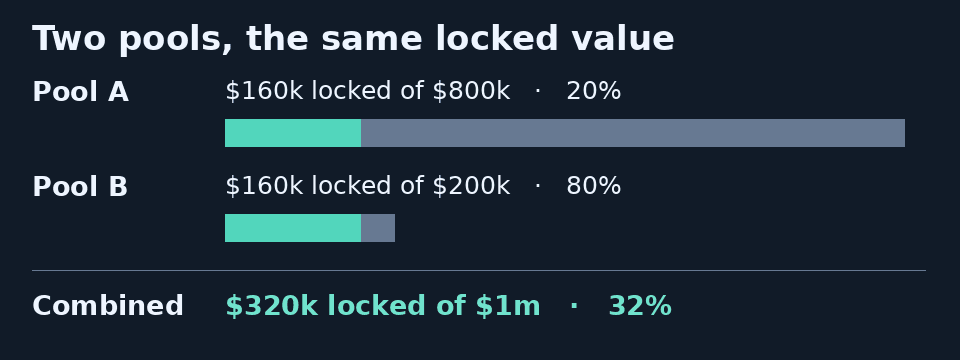
Pool A locks $160,000 of $800,000. Pool B locks $160,000 of $200,000.
Illustrative pool values. Together the two pools lock $320,000 of $1 million, or 32%.

Code examples

Read primary-pool risk evidence

curl -H "Authorization: Bearer $MADEONSOL_API_KEY" "https://madeonsol.com/api/v1/tokens/$SOLANA_MINT/risk"

Inspect locks on the specified mint

curl -H "Authorization: Bearer $MADEONSOL_API_KEY" "https://madeonsol.com/api/v1/tokens/$SOLANA_MINT/locks"

Common mistakes and fixes

Common integration mistakes and recommended fixes
MistakeRecommended fix
The scanner labels every pool locked after detecting a lock contract.Match the locked asset to its pool and check the measured remaining lock share.
Burned and locked percentages are both added to a locked-only headline.Show each component separately. Label a combined secured measure explicitly.

Verify your integration

Use the two-pool example below. Change the second pool’s lock percentage to unknown. The exact combined result should disappear while the verified minimum remains 16% of the known inventory. Remove its valuation too and suppress that bound.

Production checklist

  • Pool identifier and observation time travel with the reading.
  • A 1% lock displays as 1%.
  • An unknown pool cannot silently become a measured zero.

Frequently asked questions

Does the locks endpoint on the project mint give the LP lock percentage?

It describes locks and vesting of that mint. For primary-pool LP custody start with the risk response and its pool-scoped evidence.

Can I add raw LP units from different pools?

Each LP mint represents a different pool. Weight compatible verified shares by pool value at a common observation time.

Continue building

  • Interpret token amounts, timestamps and data quality correctly
  • Reduce MadeOnSol API calls with safe backend caching
  • Reduce REST polling in a trading terminal

Match your plan to your workload

Compare capacity, channel access and display rights before launching.

Compare plans and subscribe
Read this guide as Markdown
Live terminal demoAPI authenticationDeveloper dashboard