Concentrated liquidity is the single biggest innovation in DEX design, and Solana has three major implementations: Meteora DLMM, Orca Whirlpools, and Raydium CLMM. If you're providing liquidity on Solana and still using standard AMM pools, you're leaving significant returns on the table.
This guide explains how concentrated liquidity works across all three platforms, compares their mechanics, and gives you practical strategies for different market conditions.
Why Concentrated Liquidity Matters
In a standard AMM pool (constant-product x*y=k), your liquidity is spread across the entire price range from zero to infinity. For a SOL/USDC pool, your capital covers SOL prices from $0.001 to $1,000,000. Since SOL actually trades in a narrow band (say $100-$200 right now), over 99% of your capital sits idle, earning nothing.
Concentrated liquidity lets you deploy capital only within a specific price range. If you concentrate your liquidity between $120 and $180 for SOL/USDC, your capital works 10-50x harder than it would in a standard pool, because 100% of it is active within the trading range.
The math is straightforward: If a standard pool earns 0.5% in fees per day, and you concentrate your liquidity into 1/20th of the price range where all the trading happens, you could earn roughly 10% per day on the same capital. The returns scale with how tightly you concentrate.
The tradeoff is risk — if the price moves outside your range, you earn zero fees and are fully exposed to impermanent loss. This guide helps you manage that tradeoff.
Meteora's DLMM uses a bin-based system. The price range is divided into discrete bins, and you allocate liquidity across specific bins.
Key mechanics:
- Bins: Price is divided into fixed-width intervals. Each bin holds single-sided liquidity (either token A or token B, depending on which side of the current price it's on).
- Bin steps: Determine bin width. Options range from 1 basis point (very narrow) to 100+ basis points (wide). Smaller steps = more precision but more management.
- Dynamic fees: Fees automatically increase during high volatility and decrease during calm periods. This compensates LPs for increased impermanent loss risk during volatile periods.
- Liquidity shapes: Spot (concentrated at current price), Curve (bell curve distribution), or Bid-Ask (wider spread). You can also set custom distributions.
Best for: Memecoin pools (dynamic fees capture volatility), active LPs who rebalance frequently, novel token pairs.
Orca Whirlpools
Orca's Whirlpools use a tick-based system similar to Uniswap v3, adapted for Solana's architecture.
Key mechanics:
- Tick spacing: Determines the granularity of price ranges. Different fee tiers have different tick spacings.
- Fee tiers: 0.01%, 0.02%, 0.04%, 0.05%, 0.16%, 0.30%, 0.65%, 1%, 2%. Choose based on pair volatility.
- Range orders: Set a range above or below current price to create a limit-order-like effect.
- Auto-compounding: Some Whirlpool integrations auto-compound earned fees back into your position.
Best for: Stable pairs (USDC/USDT at 0.01%), blue-chip pairs (SOL/USDC), LPs who want set-and-forget positions with wider ranges.
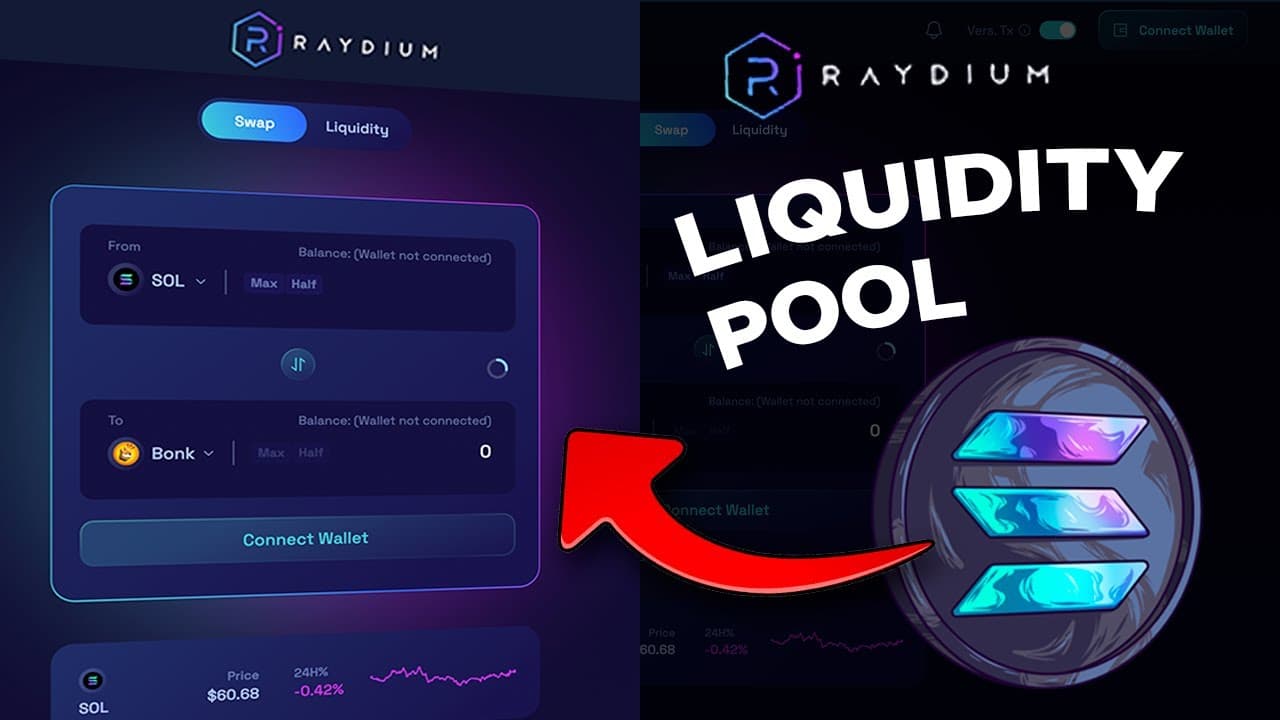
Raydium CLMM (Concentrated Liquidity Market Maker)
Raydium's CLMM is also tick-based, similar to Orca's model but with Raydium's unique pool infrastructure.
Key mechanics:
- Fee tiers: 0.01%, 0.05%, 0.25%, 1%, 2%
- Farming rewards: Some CLMM pools have additional farming incentives (RAY or partner tokens) on top of trading fees
- Deep integration: Raydium's CLMM is well-integrated with Jupiter routing, meaning your pool will capture volume from aggregator trades
- Position management: Standard range-based positions with upper and lower price bounds
Best for: Tokens that already have Raydium standard pools (existing liquidity/volume), LPs who want farming rewards in addition to fees.
Head-to-Head Feature Comparison
| Feature | Meteora DLMM | Orca Whirlpools | Raydium CLMM |
|---|
| Price model | Bin-based | Tick-based | Tick-based |
| Dynamic fees | Yes | No | No |
| Fee tiers | Per-pool (set at creation) | 9 options | 5 options |
| Liquidity shapes | Spot, Curve, Bid-Ask, Custom | Manual range | Manual range |
| Farming rewards | Some pools | Some pools | Yes (many pools) |
| Auto-compound | Via integrations | Via integrations | Manual |
| Jupiter routing | Yes | Yes | Yes |
| Best for volatile pairs | Excellent (dynamic fees) | Good | Good |
| Best for stable pairs | Good | Excellent | Good |
| UI complexity | Medium | Low | Low |

Concentrated Liquidity Strategies
Strategy 1: Tight Range on Stable Pairs
Pair: USDC/USDT, USDC/PYUSD, or similar stablecoin pairs
Platform: Orca Whirlpools (0.01% fee tier)
Range: $0.998 - $1.002
Stablecoin pairs barely move, so you can concentrate aggressively. The fee rate is low (0.01%), but your capital efficiency is extreme — all your liquidity is active essentially 100% of the time. Annual yields of 5-15% on stablecoin pairs with minimal impermanent loss risk.
Risk: Stablecoin depegs. If USDC drops to $0.95, you'll be holding 100% USDC and 0% of the other stable. Monitor stablecoin health signals.
Strategy 2: Medium Range on Blue Chips
Pair: SOL/USDC
Platform: Any of the three
Range: -20% to +30% from current price
For SOL/USDC, a range like $120-$200 (when SOL is at $155) captures normal trading activity while giving room for moderate price swings. You'll need to rebalance if SOL makes a major move, but this position can run for days or weeks without intervention.
Expected APY: Varies with volume, but 30-100% APY is realistic for actively traded pairs with tight-ish ranges.
Risk: Significant SOL move in either direction pushes you out of range. If SOL pumps to $250, you'll be holding 100% USDC with no fee income. If SOL drops to $100, you'll be holding 100% SOL at a loss.
Strategy 3: Aggressive Range on Memecoins
Pair: MEMECOIN/SOL
Platform: Meteora DLMM (dynamic fees are crucial here)
Range: Tight around current price, expect to rebalance frequently
Memecoin pools on Meteora can generate extraordinary fees — 50-500% APY during high-volume periods. The dynamic fee adjustment is essential because memecoin volatility is extreme, and you need higher fees to compensate for the impermanent loss risk.
How to approach it:
- Find a memecoin with consistent volume on Birdeye or DEXScreener
- Open a DLMM position on Meteora with "Spot" distribution
- Set bin step based on volatility (higher step for wilder tokens)
- Monitor every few hours and rebalance when price drifts to edge of range
- Withdraw when volume dies or the token shows signs of abandonment
Risk: Memecoins can go to zero. Your LP position will be 100% memecoin and 0% SOL if the price crashes. Only LP on memecoins you're willing to hold.
Strategy 4: One-Sided Range Orders
You can use concentrated liquidity as a limit order system:
- Selling SOL at a higher price: Provide single-sided SOL liquidity in a range above the current price. As the price rises into your range, your SOL is sold for USDC at your target price.
- Buying SOL at a lower price: Provide single-sided USDC liquidity below the current price. If SOL drops, your USDC buys SOL at your target price.
This earns fees while you wait for your target price, unlike a regular limit order that sits idle.
Managing Impermanent Loss
Impermanent loss (IL) is amplified in concentrated liquidity positions because your capital is more sensitive to price movements. Here's how to manage it:
Understand the IL Math
In a standard AMM, a 50% price move in either direction causes ~5.7% IL. In concentrated liquidity with a range that's 1/10th the size, the same price move (if it stays in range) causes proportionally more IL relative to your position.
However, you're also earning 10x+ more in fees. The net result depends on whether fees earned exceed IL suffered.
Rebalancing
When price approaches the edge of your range:
- Withdraw: Remove your position
- Swap: Rebalance your token ratio to 50/50 (or whatever the new position requires)
- Redeploy: Open a new position centered on the current price
Each rebalance has costs: swap fees, slippage, and transaction fees. Don't rebalance too frequently or costs eat your profits.
Use Automated Vaults
If active management sounds exhausting, automated vault protocols handle rebalancing for you:
- Kamino Finance: Automated concentrated liquidity vaults that manage Orca Whirlpool and Raydium CLMM positions
- Hawksight: Auto-compounding and range management for Solana CL positions
These vaults charge a performance fee but save you the effort of constant monitoring and manual rebalancing.
Choosing the Right Platform
Use Meteora DLMM when:
- Providing liquidity for volatile/memecoin pairs
- You want dynamic fees that protect against IL during volatility spikes
- You prefer bin-based UI for precise liquidity placement
- The pool you want is only on Meteora
Use Orca Whirlpools when:
- Providing liquidity for stable or blue-chip pairs
- You want a clean, simple interface
- The pair has an established Whirlpool with good volume
- You want to use Kamino or other auto-management vaults
Use Raydium CLMM when:
- The pair has farming incentives on Raydium
- You want to capture Jupiter aggregator volume (Raydium has deep integration)
- The token already has established Raydium liquidity
Practical Tips from Active LPs
-
Track fees vs. IL religiously: Use portfolio trackers or DeFi dashboards to monitor whether your position is actually profitable. Many LPs assume they're profitable because they see fee income, without accounting for IL.
-
Start with SOL/USDC: It's the most liquid pair with predictable behavior. Learn the mechanics before jumping into volatile pairs.
-
Match bin step / fee tier to volatility: High volatility = wider bins/higher fee tier. Low volatility = narrow bins/lower fee tier. Mismatching these costs you money.
-
Watch for volume, not just price: A token can be range-bound (good for LP) but have no volume (bad for fees). Check 24h volume on DEXScreener before deploying.
-
Set alerts: Use price alerts to know when your position is about to go out of range. Rebalancing at 90% of range is better than discovering you've been out of range for three days.
-
Consider the opportunity cost: The SOL or USDC in your LP position could be earning yield elsewhere (staking, lending). Your CL position needs to beat that baseline to be worthwhile.
Final Thoughts
Concentrated liquidity on Solana is one of the most powerful ways to generate yield, but it demands active management and a solid understanding of the tradeoffs. Meteora excels for volatile pairs with its dynamic fees, Orca provides the cleanest experience for stable/blue-chip pairs, and Raydium offers farming incentives that can boost returns.
If you're new to LP, start with our general liquidity provision guide before diving into concentrated positions. And if you want the deepest technical understanding of Meteora specifically, check out our Meteora DLMM deep dive.
The LPs who consistently profit in concentrated liquidity are those who treat it as active trading, not passive income. Choose your ranges deliberately, monitor your positions, rebalance when needed, and always calculate whether your fee income actually exceeds your impermanent loss.