Every time you swap a token on Solana, you risk losing money to invisible attackers. MEV (Maximal Extractable Value) extraction cost Solana traders an estimated $300M+ in 2025 through sandwich attacks, front-running, and back-running. Most traders don't even realize it's happening.
This guide explains exactly how MEV works on Solana, what it costs you, and — most importantly — concrete steps to minimize your exposure. If you have already read our Jito and MEV explainer, consider this the advanced tactical companion.
What MEV Actually Costs You
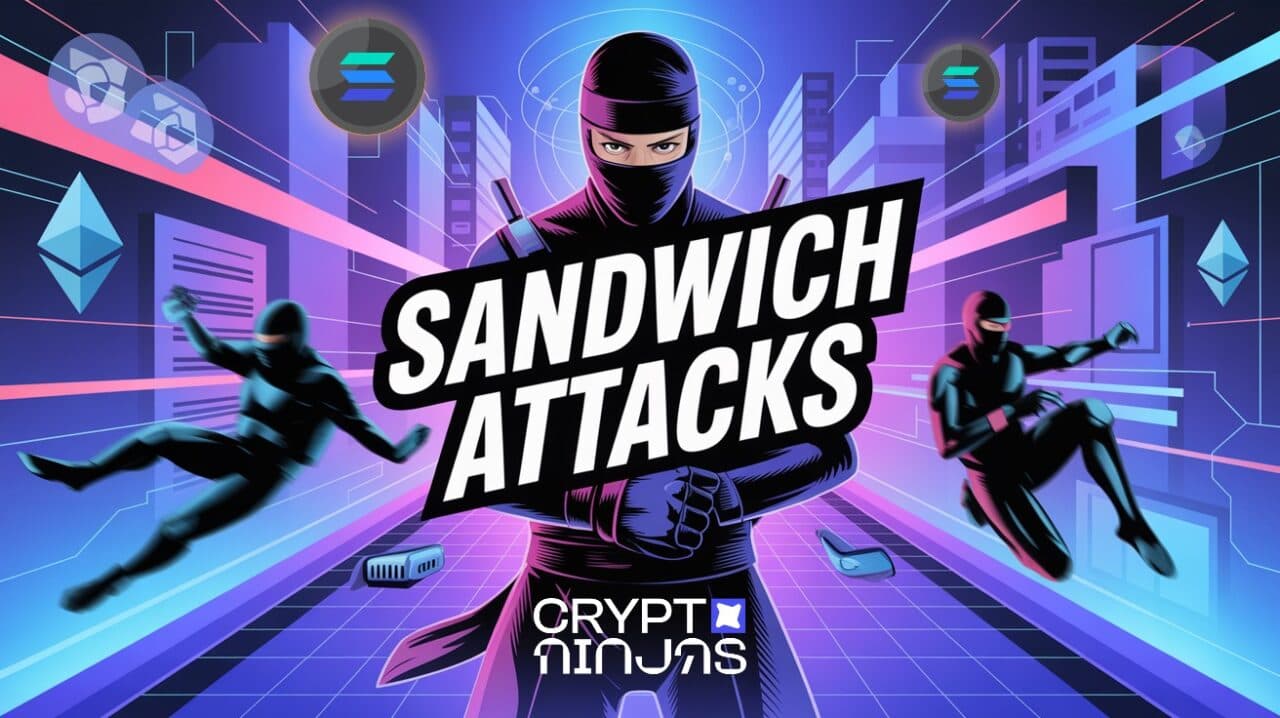
Before diving into protection strategies, understand what you're losing. MEV is not theoretical. Here is what happens in a typical sandwich attack:
- You submit a swap: Buy 50 SOL worth of Token X on Raydium
- A MEV bot detects your pending transaction
- The bot front-runs you — buys Token X first, pushing the price up
- Your swap executes at a worse price (you get fewer tokens)
- The bot back-runs you — sells immediately after your buy, pocketing the difference
On a 50 SOL trade with 2% price impact from the sandwich, you lose 1 SOL. Scale that across hundreds of trades, and the cost is significant.
Who is most vulnerable:
- Large swaps (>10 SOL) on thin liquidity pairs
- Trades with high slippage tolerance (5-10%+)
- Trades on memecoins with low liquidity depth
- Swaps routed through a single pool rather than split across venues
How MEV Works Differently on Solana
Solana does not have a public mempool like Ethereum. Transactions go directly to the current leader validator. In theory, this should make MEV harder. In practice, several mechanisms still enable it:
Validator-Level Ordering
The leader validator decides transaction order within their block. Some validators run software that identifies profitable ordering opportunities and inserts MEV transactions.
Jito introduced a block space auction system. Searchers (MEV bots) can submit "bundles" — groups of transactions that must execute in a specific order or not at all. While Jito created this system primarily for MEV protection, sophisticated bots also use the bundle mechanism to guarantee their sandwich transactions execute atomically.
Network Latency Exploitation
Bots colocated near validators (or running their own validators) see transactions microseconds before others. This speed advantage lets them insert front-running transactions before yours lands.
RPC-Level Leakage
When you submit a transaction through an RPC provider, the RPC sees your transaction before it reaches the validator. Some RPC providers (or their infrastructure) have been suspected of leaking transaction data to MEV searchers.
Protection Strategy 1: Use Private Transaction Submission
The most effective protection is preventing bots from seeing your transaction in the first place.
Jito Tips (Private Transactions)
When you send a transaction with a Jito tip, it goes through Jito's private relay rather than the public transaction path. MEV searchers cannot see it until it's already included in a block.
How to use Jito tips:
Most Solana trading tools support Jito tips natively:
- Jupiter: Enable "MEV Protect" in swap settings (uses Jito by default)
- Photon: Set Jito tip amount in settings (recommended: 0.001-0.01 SOL)
- BullX: Jito tip option in trade settings
- Axiom: Built-in Jito integration with adjustable tip
- Trojan: Configure Jito tip in bot settings
- BonkBot: Supports Jito tips in Telegram
How much to tip:
| Trade Size | Recommended Jito Tip | Why |
|---|
| < 1 SOL | 0.0001-0.001 SOL | Low value target, minimal tip needed |
| 1-10 SOL | 0.001-0.005 SOL | Moderate protection |
| 10-50 SOL | 0.005-0.01 SOL | Worth protecting, need priority |
| 50+ SOL | 0.01-0.05 SOL | High value, maximum protection needed |
The tip is a cost, but it's almost always less than what a sandwich attack would extract.
bloXroute Private Transactions
bloXroute offers a transaction protection service that submits your transactions through a private channel. It functions similarly to Jito's private relay but operates as a separate infrastructure provider.
Protection Strategy 2: Optimize Slippage Settings
Slippage tolerance is the maximum price movement you'll accept for your trade. Setting it too high is an invitation for sandwich bots.
Rules for slippage:
- Stablecoin swaps: 0.1-0.3% slippage
- Major tokens (SOL, JTO, JUP): 0.5-1%
- Mid-cap tokens: 1-3%
- Low-cap memecoins: 3-5% maximum, and only if necessary
- Never set slippage to "auto" on large trades — auto slippage often selects higher values than needed
If your transaction fails due to slippage being too low, increase in small increments (0.5% at a time) rather than jumping to 10%.
Dynamic slippage (available on Jupiter and some trading bots) automatically calculates the minimum slippage needed based on current liquidity and trade size. This is better than static slippage for most traders.

Protection Strategy 3: Split Large Trades
A 100 SOL swap is a much more attractive MEV target than ten 10 SOL swaps. Splitting trades across time reduces your MEV exposure.
Practical splitting approaches:
- Manual splitting: Execute your trade in 3-5 chunks, waiting a few seconds between each
- DCA (Dollar-Cost Averaging): Use Jupiter's DCA feature to automatically split an order over minutes, hours, or days. See our DCA guide for details
- Limit orders: Set a limit order at your target price instead of market-buying. Limit orders don't get sandwiched because they execute at a fixed price. Read our guide on Jupiter limit orders for the full walkthrough
- TWAP (Time-Weighted Average Price): Some platforms offer TWAP execution that spreads your order over a defined time window
Protection Strategy 4: Choose the Right Trading Venue
Where you trade matters for MEV exposure:
Aggregators Are Usually Safer
Jupiter splits routes across multiple pools and DEXs, which naturally reduces the MEV opportunity on any single pool. A bot would need to sandwich you across multiple venues simultaneously, which is harder and less profitable.
Direct Pool Trades Are Riskier
Trading directly on a single Raydium or Orca pool concentrates your entire price impact in one venue, making it an easy target.
Trading Bots with Built-In Protection
Modern Solana trading bots like Photon, BullX, and Axiom have MEV protection features built in. They combine Jito tips, optimized routing, and private transaction submission by default. For memecoin trading where speed matters, these tools offer the best balance of execution speed and MEV protection.
Protection Strategy 5: Transaction Settings That Matter
Priority Fees
Priority fees (separate from Jito tips) increase the priority of your transaction in the validator's queue. Higher priority means faster inclusion, which reduces the window for MEV extraction.
How priority fees differ from Jito tips:
| Feature | Priority Fee | Jito Tip |
|---|
| Paid to | Validator | Jito block engine |
| Privacy | No (public transaction) | Yes (private relay) |
| Speed benefit | Yes | Yes |
| MEV protection | Partial (faster inclusion) | Strong (hidden from bots) |
| Best for | General speed | MEV-sensitive trades |
For maximum protection, use both: a Jito tip for privacy plus a modest priority fee for speed.
skipPreflight
The skipPreflight setting in Solana transactions skips the local simulation step before submitting to the network. This saves a round-trip to the RPC node and gets your transaction to the validator faster.
When to use skipPreflight:
- Sniping new token launches where milliseconds matter
- Time-sensitive arbitrage
- Any trade where speed is more important than pre-validation
When NOT to use skipPreflight:
- Complex DeFi interactions where you want to catch errors before on-chain submission
- Large trades where a failed transaction wastes your priority fee/Jito tip
Most trading bots enable skipPreflight by default. If you're building custom transactions, enable it for speed-sensitive trades.
Protection Strategy 6: Use MEV-Aware Wallets
Phantom has built MEV protection directly into the wallet. When you swap tokens through Phantom's built-in swap feature, transactions are automatically routed through protected channels.
This is the easiest protection method for casual traders — just use Phantom's swap feature instead of connecting to a DEX directly.
Real Numbers: Before and After Protection
Here is a realistic comparison of what you might pay on a 20 SOL memecoin buy:
| Scenario | Sandwich Loss | Jito Tip | Priority Fee | Net Cost |
|---|
| No protection, 10% slippage | ~0.8 SOL | $0 | $0 | ~0.8 SOL |
| No protection, 3% slippage | ~0.3 SOL | $0 | $0 | ~0.3 SOL |
| Jito tip, 3% slippage | ~0 SOL | 0.005 SOL | 0.001 SOL | 0.006 SOL |
| Jito + split into 4 trades | ~0 SOL | 0.02 SOL | 0.004 SOL | 0.024 SOL |
The protected trades cost a tiny fraction of what an unprotected sandwich extracts.
Monitoring Your MEV Exposure
How do you know if you're being sandwiched? Look for these signs:
- Consistent worse-than-expected execution: If you're always getting close to your slippage limit, you might be getting sandwiched
- Transactions surrounded by similar trades: On Solscan, check if your swap transaction is immediately preceded and followed by swaps of the same token pair from the same wallet
- Higher-than-normal price impact: If your 5 SOL trade shows 3% price impact on a pool with deep liquidity, something is wrong
Tools like Birdeye and DEXScreener show transaction-level detail where you can spot sandwich patterns.
Final Thoughts
MEV protection on Solana boils down to three principles: hide your transactions (Jito tips), minimize your target profile (low slippage, split trades), and use tools with built-in protection (trading bots, Phantom).
The cost of protection is minimal — a few hundredths of a SOL in Jito tips per trade. The cost of no protection is potentially significant, especially on large trades or illiquid tokens.
Make Jito tips your default. Set slippage deliberately rather than using auto. Split large trades. These three habits alone will save you more than most "alpha" strategies will earn you.
For more trading optimization, see our guides on slippage settings, stop-loss strategies, and the best Solana trading bots.