Solana AI Agents & x402: How AI Pays on the Blockchain (2026)
As of September 2026, Solana reports 37M+ x402 transactions, 20K+ buyers and sellers, and 70% of monthly x402 volume. This guide explains the protocol, agent tooling, and the infrastructure around autonomous payments.
MadeOnSol··Updated · 7 min read
Disclosure: This article contains affiliate links. If you sign up through them, MadeOnSol may earn a commission at no extra cost to you. This never affects our rankings, ratings, or reviews.
Building a product on Solana or Robinhood Chain data?
Skip the Geyser pipeline — embed KOL flow, deployer reputation, and the all-DEX firehose over REST, WebSocket, or webhooks. The Business tier (€400/mo) is the self-serve embed license at 500k calls/day — Enterprise adds white-label & redistribution.
Solana also documents an Agent Registry: an open on-chain protocol for verifiable agent identity, portable reputation and validation infrastructure, interoperable with the ERC-8004 model. This refresh avoids repeating an unverified launch-day agent count.
It consists of three components:
Identity Registry — unique on-chain identifiers for agents
Reputation Registry — track record of agent behavior and reliability
Validation Registry — verification of agent capabilities and permissions
This is Solana's answer to the question "how do you trust an autonomous agent?" — by giving it a verifiable on-chain identity and reputation score.
Real Use Cases
Autonomous API payments: AI agents paying per-request for premium APIs, web scraping, and market data using USDC — no API keys or subscriptions needed
DeFi automation: Agents checking yields across Solana DEXs and reallocating funds for maximum returns. Staking, liquidity provision, and reward claims happen autonomously.
Autonomous trading: Agents monitoring markets, executing trades, and rebalancing portfolios with hundreds of daily transactions
Content payments: AI agents paying for premium content, research data, and compute resources via x402 micropayments
Notable AI Agent Tokens
Token
Description
GOAT (Goatseus Maximus)
First token endorsed by an autonomous AI agent (Truth Terminal). Reached $1B+ market cap.
ELIZAOS
Token for the ElizaOS framework. 7.4B circulating supply.
Associated with the ZerePy framework. Peaked at ~$800M market cap.
VIRTUAL
Virtuals Protocol. Agent Commerce Protocol for autonomous agent-to-agent transactions.
Total AI agents crypto market cap: approximately $2.67B as of late March 2026.
What This Means for Solana
Agentic-payment infrastructure is already live on Solana, with the official x402 hub reporting 37M+ transactions. The combination of x402 payments, the Agent Registry, and multiple development frameworks creates a full stack for autonomous AI:
Building a product on Solana or Robinhood Chain data?
MadeOnSol isn't an RPC or another generic token API — it's Solana & Robinhood Chain memecoin intelligence that's painful to build in-house, pulled from dual-region gRPC shred streams and our own Robinhood Chain node, pushed to your app as events land.
Signals you'd otherwise build
KOL & smart-money flow from 2,000+ labeled wallets, deployer reputation, coordination clusters, linked-wallet entity resolution, and an all-DEX firehose.
Embed it in your product
The Business tier (€400/mo, self-serve) licenses you to display MadeOnSol data inside your own product — 500k calls/day, 15 WS + 6 firehose connections. Enterprise above adds white-label & redistribution rights and custom endpoints.
Evaluate first, commit later
Test everything on a free ULTRA key — no commitment. If it fits, we scope volume or white-label pricing.
As of September 2026, Solana's x402 hub reports 37M+ transactions, 20K+ buyers and sellers, and 70% of monthly x402 volume on Solana. Those are the first-party figures we can verify today, so this refresh uses them instead of older weekly-share and cumulative-dollar estimates. This guide covers what x402 is, how it works, which frameworks developers use, and what this means for the Solana ecosystem.
What Is x402?
x402 is an open payment protocol developed by Coinbase that revives the long-dormant HTTP status code 402 ("Payment Required") to embed stablecoin payments directly into standard HTTP requests.
How It Works
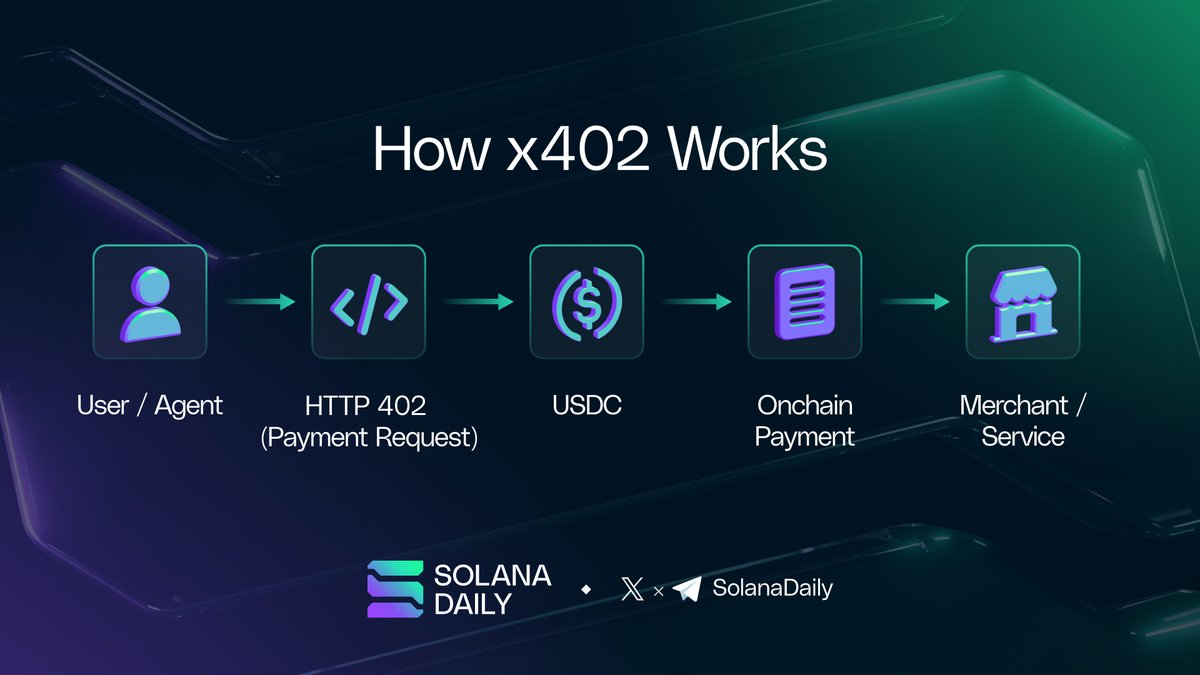
An AI agent makes an HTTP request to a server (e.g., requesting API data, compute, or content)
The server responds with HTTP 402 Payment Required plus a machine-readable header containing payment terms (amount, asset, recipient address)
The agent signs a USDC payment on Solana and retries the request with cryptographic proof
The server verifies the payment and serves the resource
No API keys. No subscriptions. No human intervention. The AI agent pays per-request with USDC and gets what it needs.
Key Facts
Metric
Value
Launch date
May 6, 2025 (V1); December 11, 2025 (V2)
Solana transactions (cumulative)
37M+
Solana buyers + sellers
20K+
Solana share of monthly x402 volume
70%
Current protocol line
x402 V2 for new integrations
Supported chains
Solana, Base, Ethereum, Polygon, Stellar
The x402 Foundation was established in September 2025, co-founded by Coinbase and Cloudflare. Members include Google and Visa. Cloudflare integrated x402 into its Agents SDK and MCP servers.
Important context: transaction counts and payment volume measure protocol activity, not the economic usefulness of every call. Treat the Solana hub figures as adoption indicators rather than proof that every transaction was generated by a distinct autonomous agent.
Why Solana for AI Agents?
Three factors make Solana the natural fit (for a broader primer on what these agents are and the best projects building them, see our Solana AI agents guide):
Low-cost settlement: Solana makes small-value stablecoin payments practical, especially when the resource price itself is only fractions of a cent or a few cents.
Fast settlement infrastructure: the chain is designed for high-throughput applications, and Solana is also developing payment-channel primitives for workloads where settling every tiny call individually becomes inefficient.
x402 infrastructure: clients, facilitators and server tooling can handle the payment challenge/verification flow without inventing a bespoke billing protocol.
The Solana ecosystem is explicitly investing in agentic-payment infrastructure: its official documentation now includes x402 V2 flows and, in September 2026, the Foundation published payment-channel work aimed at high-frequency agent payments.
AI Agent Frameworks on Solana
ElizaOS (formerly ai16z)
The most popular open-source framework for autonomous AI agents. Created by Shaw Walters, ElizaOS is a TypeScript-based agent operating system with 17,600+ GitHub stars and 200+ plugins.
Agents can operate across Discord, Twitter, and Telegram with persistent personalities
Powered by LLMs from OpenAI, Anthropic, and others
The ELIZAOS token (formerly AI16Z) migrated in November 2025 with a 1:6 swap ratio
Connects AI agents to 30+ Solana protocols with 60+ pre-built actions: token swaps, NFT minting, staking, lending, and more. Integrates with LangChain, Vercel AI SDK, and ElizaOS.
The fastest way to give an LLM-based agent the ability to interact with Solana DeFi.
Other Frameworks
GOAT Toolkit (by Crossmint) — Universal adapter supporting 30+ blockchains with 200+ plugins. Covers Jupiter, Orca, Uniswap, and Aave.
Rig — Rust-native framework for performance-critical agents. Ideal for high-frequency trading bots and MEV strategies due to lowest-latency LLM-to-chain execution.
ZerePy — Python framework for building agents capable of social and on-chain actions on Solana.
The infrastructure is live, but the adoption metrics should be read as protocol activity rather than as a forecast for what share of all future Solana transactions agents will generate.
FAQ
What is x402 on Solana?
x402 is an open payment protocol that uses the HTTP 402 status code to embed USDC payments into standard web requests. On Solana, AI agents use x402 to pay for APIs, data, and compute resources autonomously — no API keys, subscriptions, or human intervention required. Solana's current x402 hub reports 37M+ transactions on the network.
How do AI agents use Solana?
AI agents on Solana use frameworks like ElizaOS and Solana Agent Kit to interact with DeFi protocols, execute trades, manage portfolios, and make payments. Solana's low-cost, high-throughput payment rails make repeated machine-to-machine payments practical, while payment channels are being developed for even denser agent workloads.
What is the Solana Agent Registry?
The Solana Agent Registry is an open on-chain protocol for verifiable identity, portable reputation and validation infrastructure, designed to interoperate with ERC-8004.
The metrics in the original version had drifted and mixed third-party estimates with first-party figures. Solana's current x402 hub reports 37M+ transactions, 20K+ buyers and sellers, and 70% of monthly x402 volume. New integrations should follow x402 V2 rather than V1 headers/network names. The Agent Registry section is now anchored to Solana's own current description, and unsupported facilitator shares, launch-day counts and transaction-share forecasts were removed.