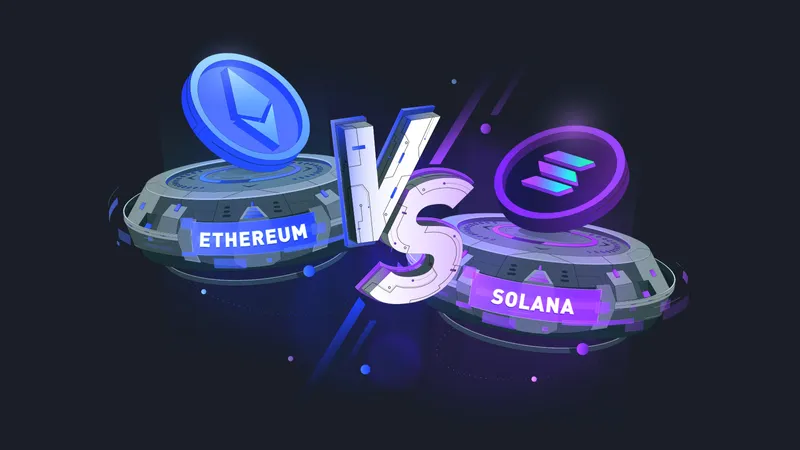
Solana and Base have emerged as the two most active chains for retail DeFi activity and memecoin trading in 2026. Both attract builders, traders, and capital — but they take fundamentally different approaches to the same problems.
Solana is a standalone Layer 1 blockchain built from scratch for speed. Base is Coinbase's Layer 2 rollup built on top of Ethereum. That architectural difference shapes everything: transaction speed, fee structures, ecosystem design, and what's possible on each chain.
This comparison breaks down the real differences across every metric that matters for DeFi users and traders. Both chains have genuine strengths, and the right choice depends on what you're trying to do.
Architecture: L1 vs L2
Understanding the architecture explains most of the practical differences between these chains.
Solana — Independent L1
Solana is a monolithic Layer 1 blockchain with its own consensus mechanism (a combination of Proof of Stake and Proof of History). Every Solana validator processes every transaction. The network doesn't rely on any other chain for security or finality.
Key architectural features:
- Proof of History: A cryptographic clock that orders transactions before they're processed, enabling parallel execution
- Gulf Stream: Transaction forwarding to validators before the current block is finalized
- Sealevel: Parallel smart contract runtime — multiple transactions can execute simultaneously if they don't touch the same state
- Turbine: Block propagation protocol optimized for speed
This architecture delivers raw throughput but means Solana must handle everything itself — consensus, execution, and data availability on one layer.
Base — Ethereum L2 Rollup
Base is an OP Stack (Optimistic Rollup) Layer 2 that processes transactions off Ethereum mainnet and periodically posts compressed data back to Ethereum L1 for finality.
Key architectural features:
- Sequencer: Base currently runs a centralized sequencer (operated by Coinbase) that orders and batches transactions
- L1 security: Ultimately inherits Ethereum's security — transaction data is posted to Ethereum, and anyone can challenge incorrect state transitions
- EVM compatible: Runs the same Ethereum Virtual Machine, so Ethereum dApps can deploy to Base with minimal changes
- OP Stack: Built on Optimism's open-source rollup framework, part of the Superchain vision
This architecture means Base gets cheap transactions while borrowing Ethereum's security guarantees — but with trade-offs in decentralization and finality timing.
Speed and Finality
| Metric | Solana | Base |
|---|
| Block time | ~400ms | ~2 seconds |
| Transaction confirmation | ~1-2 seconds | ~2-4 seconds |
| True finality | ~1-2 seconds (single slot) | ~7-14 days (L1 challenge period) |
| Practical finality | Instant for users | Instant for users (sequencer confirmation) |
| Throughput (sustained) | 3,000-5,000 TPS | 50-100 TPS (growing) |
| Theoretical max TPS | 65,000+ (Firedancer targeting 1M+) | Limited by L1 data posting and sequencer |
For everyday users, both chains feel fast. Swaps confirm in 1-4 seconds on either chain, which is more than adequate for most DeFi activity.
For competitive trading (sniping, arbitrage, MEV), Solana's 400ms blocks provide a genuine edge. When you're racing other traders to buy a token at launch, every millisecond counts. Base's 2-second blocks are fast by Ethereum standards but measurably slower than Solana.
Finality nuance: Solana transactions are final once confirmed — there's no rollback mechanism outside of rare network-level issues. Base transactions are "soft confirmed" by the sequencer instantly, but true L1 finality (where the transaction is mathematically guaranteed by Ethereum) takes the full challenge period. In practice, this rarely matters for users, but it's relevant for bridges and large institutional transfers.
Transaction Fees
| Fee Type | Solana | Base |
|---|
| Base transaction | ~$0.00025 | ~$0.001-$0.01 |
| Simple swap | $0.01-$0.10 | $0.02-$0.20 |
| With priority fees | $0.05-$1.00 | $0.05-$0.50 |
| During congestion | $0.50-$5.00 (Jito tips) | $0.10-$2.00 |
| NFT mint | $0.01-$0.05 | $0.05-$0.50 |
Both chains are cheap enough that fees are rarely a barrier for regular users. The difference is marginal for normal activity — both cost pennies per transaction under normal conditions.
Where fees diverge:
- High-frequency trading: If you make 100+ trades per day, Solana's lower base fee adds up to meaningful savings
- MEV competition: Solana's Jito tip system can get expensive during peak memecoin launches ($1-$5+ per transaction), while Base's MEV landscape is less mature
- Bridging costs: Getting assets onto Base from Ethereum L1 costs Ethereum gas fees ($5-$50+). Solana has no comparable bridging tax — funds arrive directly
DeFi Ecosystem
Total Value Locked
| Metric | Solana | Base |
|---|
| Total TVL | ~$10-12B | ~$4-6B |
| Top DEX TVL | Jupiter/Raydium (~$4B+) | Aerodrome/Uniswap (~$2B+) |
| Lending TVL | ~$3B (Kamino, Drift, MarginFi) | ~$1.5B (Aave, Morpho, Moonwell) |
| Liquid staking | ~$3B (Jito, Marinade, Jupiter) | N/A (no native staking) |
Solana's TVL advantage is significant, driven partly by native staking and liquid staking protocols that have no equivalent on Base (since Base doesn't have its own proof-of-stake system — that's Ethereum L1's domain).
DEX Volume
This is where things get interesting. Both chains compete for top DEX volume:
| Metric | Solana | Base |
|---|
| Daily DEX volume (typical) | $2-5B | $1-3B |
| Daily DEX volume (peak) | $10B+ | $5B+ |
| Primary DEXs | Jupiter, Raydium, Orca, Meteora | Aerodrome, Uniswap v3, BaseSwap |
| Aggregator dominance | Jupiter (~70% of volume) | No single dominant aggregator |
Solana typically leads in raw DEX volume, driven by memecoin trading activity and the velocity of capital enabled by sub-second finality. Jupiter has established itself as the dominant DEX aggregator on any chain, routing the majority of Solana's swap volume through optimal paths across all liquidity sources.
Lending and Borrowing
Both chains have mature lending markets. Solana offers Kamino Finance, Drift, MarginFi, and Jupiter Lend. Base offers Aave (the DeFi blue chip), Morpho, Moonwell, and Compound forks.
Ethereum DeFi protocols tend to deploy to Base early given EVM compatibility, which gives Base access to battle-tested code from Aave and others. Solana's lending protocols are purpose-built for the chain, which allows deeper integration with Solana-specific features like flash loans and oracle designs.
Memecoin Ecosystem
This is the category where Solana has the clearest lead.
Solana Memecoins
Solana is the dominant chain for memecoin creation and trading in 2026:
- Pump.fun: Processes thousands of token launches daily with an instant bonding curve mechanism. No equivalent on Base matches its volume or cultural momentum
- Trading tools: Photon, BullX, Axiom, and GMGN all started as Solana-first tools (some now support multiple chains)
- Culture: Solana's memecoin culture — driven by Crypto Twitter, Pump.fun's social features, and the speed of the network — has created a self-reinforcing ecosystem where the most active traders, the best tools, and the biggest launches all concentrate on Solana
Base Memecoins
Base has its own memecoin scene, but it's smaller and structurally different:
- friend.tech legacy: Base's early social-fi experiments (friend.tech, Farcaster ecosystem tokens) brought initial attention, but the memecoin culture never matched Solana's intensity
- Launch infrastructure: Base has several launch platforms, but none have achieved Pump.fun's market share or cultural status
- EVM tooling: Ethereum-native tools like Uniswap and DEXScreener work on Base, but the specialized sniping and trading infrastructure is less developed than Solana's
- Coinbase distribution: Base benefits from Coinbase Wallet integration and the ability to onboard users directly from the Coinbase exchange — a genuine advantage for new users
Trading Bot and Tool Ecosystem
| Tool Category | Solana | Base |
|---|
| DEX aggregators | Jupiter (dominant) | 1inch, Odos, Paraswap |
| Sniping tools | Photon, BullX, Axiom, GMGN, Trojan | BullX (multi-chain), Maestro, Banana Gun |
| Analytics | Birdeye, DEXScreener, GMGN | DEXScreener, Dextools, DEX Screener |
| Token scanners | RugCheck, SolSniffer, MadeOnSol Scanner | TokenSniffer, GoPlus, De.Fi |
| Portfolio tracking | Step Finance, Birdeye, Asset Dash | Zapper, DeBank, Zerion |
| Copy trading | GMGN, Axiom, BullX | Limited options |
| Wallet | Phantom, Solflare, Backpack | Coinbase Wallet, MetaMask, Rabby |
Solana's trading tool ecosystem is deeper and more specialized, particularly for fast-paced memecoin trading. Tools like Photon and Axiom were purpose-built for Solana's speed characteristics.
Base benefits from the broader EVM tooling ecosystem. Any Ethereum tool that supports EVM chains can typically add Base support with minimal effort, which means Base has access to mature tools like Zapper, DeBank, and MetaMask from day one.
Developer Experience
Solana Development
- Languages: Rust (primary), Anchor framework (abstraction over raw Rust), and growing TypeScript SDK support
- Learning curve: Steep. Solana's account model is fundamentally different from EVM's storage model, and Rust is not a beginner-friendly language
- Tooling: Anchor, Solana CLI, Metaplex (NFTs), Helius and Triton (RPCs and APIs)
- Unique capabilities: Parallel execution, composability across programs, compressed state via ZK compression
- Developer count: Growing but smaller than EVM ecosystem
Base Development
- Languages: Solidity (same as Ethereum), Vyper
- Learning curve: Lower if you already know EVM development. Identical to deploying on Ethereum, Arbitrum, or Optimism
- Tooling: Hardhat, Foundry, Remix — the entire Ethereum tooling stack works out of the box
- Unique capabilities: Inherits Ethereum's composability, extensive existing audit infrastructure
- Developer count: Access to the full EVM developer pool (largest in crypto)
Verdict: Base has a significant developer experience advantage due to EVM compatibility. Any Solidity developer can deploy to Base immediately. Solana requires learning Rust and understanding a different programming model, which is a real barrier. However, Solana's architecture enables performance characteristics that aren't possible on EVM chains.
Network Reliability
This used to be a clear win for Base, but the gap has narrowed significantly.
Solana
Solana's early reputation for outages (2022-2023) has been mostly resolved. With the rollout of Firedancer validators (the independent client built by Jump Crypto) and QUIC networking improvements, Solana's uptime in 2025-2026 has been excellent:
- No full network halts in over a year
- Congestion during peak memecoin launches can still degrade transaction landing rates, but the network stays operational
- Validator client diversity (Agave + Firedancer) means a bug in one client doesn't necessarily take down the network
Base
Base has been remarkably stable, partly because:
- A centralized sequencer is simpler to maintain than a decentralized validator network
- The OP Stack is battle-tested across Optimism, Base, and other rollups
- Coinbase operates the infrastructure with enterprise-grade reliability standards
The trade-off is decentralization. Base's centralized sequencer means Coinbase could theoretically censor transactions or experience single-point-of-failure downtime. The roadmap includes sequencer decentralization, but it's not implemented yet in early 2026.
Wallet and Onboarding
| Factor | Solana | Base |
|---|
| Primary wallet | Phantom | Coinbase Wallet / MetaMask |
| Mobile experience | Excellent (Phantom mobile) | Good (Coinbase Wallet mobile) |
| Fiat on-ramp | Phantom on-ramp, MoonPay, exchanges | Coinbase direct (seamless) |
| New user friction | Medium (need to learn Solana concepts) | Low (Coinbase users can start instantly) |
| Account abstraction | Limited | Growing (EIP-4337 support) |
Base has a legitimate onboarding advantage through Coinbase integration. A Coinbase user can start using Base with their existing account and fund it directly from their exchange balance. Solana requires setting up a separate wallet, learning about SOL for gas, and understanding the Solana-specific ecosystem.
However, Phantom has become one of the most polished wallet experiences in all of crypto. Its mobile app, built-in swap aggregation, staking interface, and NFT gallery make it an exceptionally user-friendly entry point for Solana.
Side-by-Side Summary
| Category | Solana | Base | Winner |
|---|
| Speed | 400ms blocks, ~1s finality | 2s blocks, ~3s confirmation | Solana |
| Fees | ~$0.001-$0.10 | ~$0.01-$0.20 | Solana (marginal) |
| DeFi TVL | $10-12B | $4-6B | Solana |
| DEX volume | $2-5B daily | $1-3B daily | Solana |
| Memecoin ecosystem | Dominant (Pump.fun, sniping tools) | Growing but smaller | Solana |
| Lending/borrowing | Strong (Kamino, Drift) | Strong (Aave, Morpho) | Tie |
| Developer experience | Steeper (Rust/Anchor) | Easier (Solidity/EVM) | Base |
| Tooling breadth | Deep for trading | Broad from EVM ecosystem | Context-dependent |
| Network reliability | Excellent (improved) | Excellent | Tie |
| Decentralization | 1,500+ validators | Centralized sequencer | Solana |
| Onboarding | Phantom (great but separate) | Coinbase integration (seamless) | Base |
| Staking yield | 7-8% native | None (Ethereum L1 staking separate) | Solana |
| Institutional presence | ETFs, Grayscale, VanEck | Coinbase backing | Tie |
Which Chain Should You Use?
Choose Solana if you:
- Trade memecoins actively and need the fastest execution
- Want native staking yield on your holdings
- Value the deepest trading tool ecosystem (Photon, BullX, Axiom, Jupiter)
- Prioritize decentralization over Coinbase's centralized sequencer
- Want access to Pump.fun launches, deployer tracking, and Solana-specific alpha tools
Choose Base if you:
- Already have a Coinbase account and want the smoothest onboarding
- Are an EVM developer deploying Solidity contracts
- Want access to battle-tested Ethereum DeFi protocols (Aave, Uniswap, Compound)
- Trade across multiple EVM chains and want one wallet (MetaMask) for everything
- Prefer Coinbase's institutional backing and regulatory compliance
Use both if you:
- Are an active DeFi user who wants access to the best opportunities regardless of chain
- Have a core position staked on Solana and actively trade on whichever chain has the best opportunity
- Want to diversify blockchain exposure
The chains serve different strengths. Solana excels at high-frequency, speed-sensitive activity like memecoin trading and real-time DeFi. Base excels at accessibility, EVM compatibility, and bringing Coinbase's user base on-chain. Both are legitimate ecosystems worth understanding.
For the Solana ecosystem specifically, tools like Jupiter for swaps, DEXScreener and Birdeye for analytics, and Phantom for wallet management make the ecosystem practical and accessible. You can explore the full directory of Solana tools at MadeOnSol to find the right stack for your trading style.