Should an AI agent connect through MCP, pay with x402, or buy an API subscription?
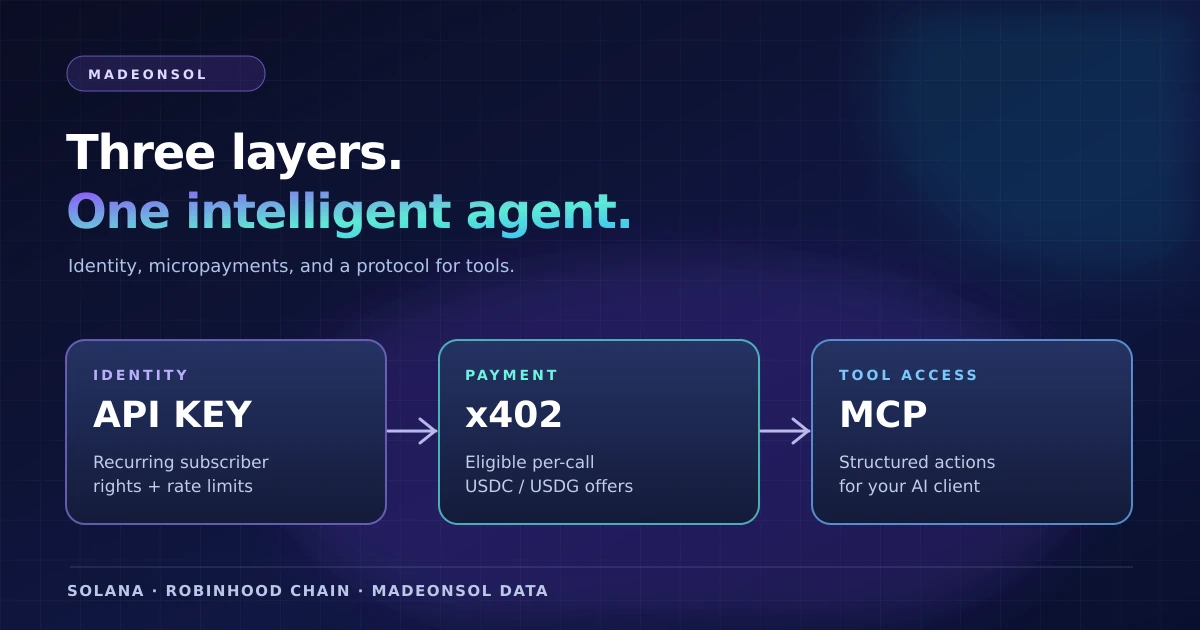
The question sounds like a three-way choice, but the options are not peers. MCP is a protocol for exposing tools to an AI client. x402 is a way to pay for an eligible HTTP request. A subscription defines recurring authorization, quota and commercial data access. An agent can use MCP and a subscription at the same time. Some MCP tools can also pay for x402 data, but that does not turn every MCP capability into a keyless endpoint.
For Solana and Robinhood Chain research agents, misunderstanding that distinction leads to repeated settlement costs, incorrect claims about access, or unnecessary bespoke infrastructure. This guide compares the access models in the context of MadeOnSol's existing API, MCP servers and Agent Intelligence Gateway.
If you're building an actual token research workflow, read Build a Solana and Robinhood Chain Memecoin Research Agent. For the earlier protocol introduction, read the Solana x402 guide rather than re-learning HTTP 402 here.
The comparison in one table
| Question | API subscription | x402 data call | MCP tool |
|---|
| How does the agent identify itself? | An account-owned API key | A valid payment authorization for the chosen offered leg | Through the MCP client and its configured backend credentials |
| How is data paid for? | Recurring plan and its quota/entitlement rules | Per eligible paid HTTP request | MCP has no billing model; depends on API-key or wallet-funded tool |
| Best fit | High-volume, recurring jobs; terminal and bot backends | An isolated investigation or sporadic paid data lookup | Claude, Cursor and agents that need structured callable tools |
| Main operational concern | Tier and quota enforcement | Payment verification, settlement, recovery and spend budget | Tool discovery, client transport, credential handling and permissions |
| Do all capabilities appear? | Only what the subscriber tier permits | Only the published priced routes | Only the registered tools supported by the configured auth mode |
| Can it sign or execute trades? | No; data access only | Signs data-payment authorization, not a swap | MCP data tools do not trade; any unrelated execution tools require separate safeguards |
MCP and x402 are complementary. Neither is a workaround for an endpoint's underlying entitlement boundary.
Option 1: API subscriptions for recurring agents
A production bot that checks hundreds of tokens daily usually benefits from a predictable account-backed API. Its data provider needs to enforce quotas, apply a known support tier and let operators monitor usage over time.
With MadeOnSol, a subscriber calls keyed REST endpoints using an account's msk_ API key:
curl -H "Authorization: Bearer $MADEONSOL_API_KEY" \
  "https://madeonsol.com/api/v1/kol/coordination?period=1h&min_kols=2&limit=10"
The key identifies a subscriber and their current effective tier. A composite agent tool should preserve that same tier instead of using an internal operator's unrestricted key.
For example, a evaluate_token action might combine several source observations into one evidence-backed report. The user must not gain access to a restricted source just because the high-level action itself is available.
Which plan?
A light, human-supervised research workflow may fit a different tier from an always-on monitoring bot. High-frequency intelligence, streaming and certain specialized signals have stronger entitlements. Never assume that PRO exposes ULTRA-only ShredPrism data or that every source shares the same plan requirement.
If your product displays MadeOnSol data to your own paying users, that is a different use case from personal research. Review the BUSINESS or Enterprise rights and contract before redistributing intelligence. The current pricing page and API reference are authoritative; this article deliberately avoids hardcoding subscription prices that may change.
Option 2: x402 pay-per-call for selective, wallet-funded research
A developer might want to check one token risk report without keeping an API subscription active. In that case an eligible MadeOnSol x402 data endpoint offers a machine-readable payment challenge.
A basic discovery request starts unpaid:
curl -i "https://madeonsol.com/api/x402/kol/feed"
The server's HTTP 402 response specifies accepted network/asset/amount combinations. A suitable x402 client validates the offer, signs the appropriate authorization within its budget and retries the exact request. The settlement and result recovery logic protect against charging an agent twice for a retry or leaving a settled payer without a usable answer.
Solana USDC versus Robinhood Chain USDG
Solana-native priced data endpoints use USDC on Solana. Some RHC data endpoints offer two settlement legs: native USDG on Robinhood Chain (chain ID 4663) and USDC on Solana. The asset and network must be taken from the actual accepts[] offer and selected authorization — not inferred from the chain whose data the API returns.
The same RHC token report can describe RHC activity while the payment is made through a Solana USDC leg. A financial dashboard that labels every RHC request "USDG" is therefore incorrect.
Check the current Solana x402 catalog and current RHC payment options for exact priced routes and offered legs. A future Agent Gateway composite is not automatically x402-payable just because it calls an individually priced risk or wallet endpoint internally.
How much will x402 actually cost?
Calculate the expected call volume and measured fees. A simplified cost model is:
estimated monthly pay-per-call cost
  = (eligible paid requests × actual price per request)
    + measured settlement/facilitator costs, if charged to the buyer
    + retries that legitimately require a new authorization
For example, 5,000 calls at a hypothetical $0.02 per call cost $100 in data charges before any additional costs. That is just an arithmetic illustration of one price point — not a quoted composite-Gateway price, a promise that all routes cost $0.02, or a comparison to a euro-denominated subscription without exchange-rate and entitlement adjustments.
A useful break-even estimate divides a plan's applicable monthly cost by the same eligible endpoint's effective paid-call price. But you must also compare quota, source access, freshness, commercial display rights and whether multiple lower-level x402 calls would be needed for the same question. A cheaper-looking price cannot buy an unavailable API capability.
Wallet policy matters
Production wallet-funded agents need explicit ceilings: allowed merchant, allowed facilitator, network/asset allowlist, per-authorization cap and total budget. Do not print seed phrases or private keys, keep repeat authorizations bounded, verify the result and recover the same paid request after a timeout instead of signing a new payment blindly.
The x402 payment signature is not permission to execute a token swap. MadeOnSol supplies data, not trade execution.
Option 3: MCP is the interface your model understands
A language model cannot spontaneously call an HTTP endpoint unless a tool client exposes that operation with arguments and descriptions. Model Context Protocol (MCP) does that.
MadeOnSol already has local MCP servers for Solana and Robinhood Chain, described in the MCP setup reference. A typical Claude Desktop or Cursor configuration invokes the installed server through local stdio and provides a subscriber API key:
{
  "mcpServers": {
    "madeonsol": {
      "command": "npx",
      "args": ["-y", "mcp-server-madeonsol"],
      "env": {
        "MADEONSOL_API_KEY": "msk_replace_with_your_own_key"
      }
    }
  }
}
This example uses an API-key-backed MCP tool path. It is not proof that a public hosted MCP server exists at a particular URL, and it does not give an agent permission to use account administration or other customers' data.
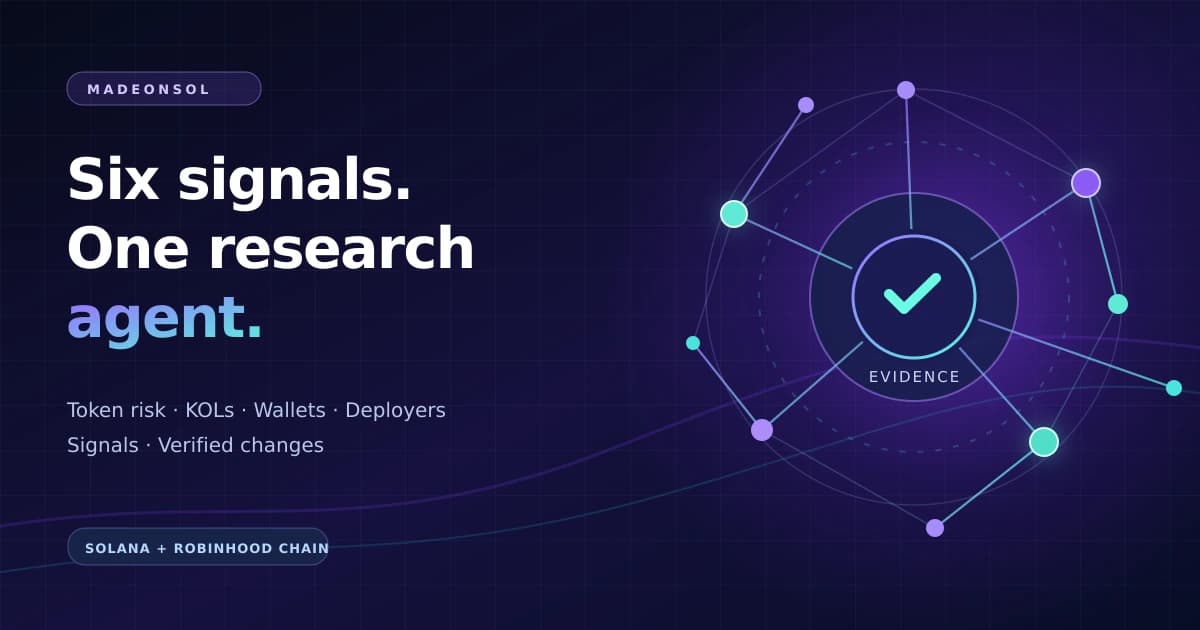
The new Agent Intelligence Gateway is designed to expose six higher-level research intents rather than expecting each language model to choose dozens of lower-level API tools manually: discover_opportunities, evaluate_token, inspect_wallet, inspect_deployer, evaluate_signal and changes_since. Check the installed MCP server’s tool list before building a workflow, and enable its subscriber Gateway tools with your own paid API key.
Local MCP and hosted multi-tenant MCP are not interchangeable
A local MCP server running on your machine can use an API key you configure. A public multi-tenant MCP service requires authenticated principals, rate limits, proper connection handling, origin safety and tenant isolation. Publishing a private operator-only HTTP adapter behind a reverse proxy is not a substitute.
A well-designed gateway lets the agent decide which read-only research action to call while keeping billing and source authorization on the server.
The Agent Gateway example: one research action, multiple possible sources
Suppose an agent is asked: "What has changed about this token, and should it be escalated for human review?"
It could call evaluate_token for a structured token assessment, then inspect_deployer for the creator's history. If a named tracked KOL appears among buyers, inspect_wallet can put that observation in context. evaluate_signal can answer how frequently the relevant signal was historically followed by a measured outcome.
Finally, changes_since can continue from a signed, source-scoped cursor. It must report gaps or stalled sources; it cannot promise an exhaustive event stream across all Solana transactions or all Robinhood Chain transfers.